
10 Best Waterfalls in Japan: The Three Great Falls and the Top 100 Waterfalls List
10 Best Waterfalls in Japan: The Three Great Falls and the Top 100 Waterfalls List
The Three Great Waterfalls of Japan is a popular nickname for the country's most iconic cascades, while the Top 100 Waterfalls is an official list selected in 1990 from over 341,000 public nominations. Understanding the difference between these two frameworks makes choosing your next waterfall destination far easier -- whether you prioritize fame or variety of experience.
The Three Great Waterfalls of Japan is a widely used nickname, while the Top 100 Waterfalls is an official list chosen in 1990 from a staggering 341,292 public nominations. Once you grasp this distinction, narrowing down which waterfall to visit becomes much simpler. Are you drawn to the household names, or do you want a broader range of experiences? Having that single decision point makes it far easier to find the right waterfall for your itinerary.
This guide focuses on ten waterfalls that are genuinely useful for trip planning. Starting with the classic trio -- Kegon Falls, Nachi Falls, and Fukuroda Falls -- and adding standouts like Shomyo Falls, Shiraito Falls (Shizuoka), and Manai Falls, these ten were selected for how well they lend themselves to real comparisons. Height, width, viewing style, best seasons, and ease of access by public transit or car are all measured on the same scale, so this guide works whether you are chasing dramatic scenery or trying to minimize travel time.
If raw power is what you are after, height and water volume alone will not tell the full story. The spiritual context surrounding a waterfall, how easy it is to walk around, and whether you can experience it from a boat or from behind the curtain of water all factor in. By the end, you should have a clear picture of which single waterfall best matches the kind of trip you want to take.
What Makes a Waterfall Famous in Japan? Understanding the Three Great Falls and the Top 100 List
Waterfall Basics and Types
The term "meibaku" (famous waterfall) gets thrown around a lot in Japanese travel writing, but it is worth noting that there is no official government definition for the word. It is a general label used across tourism, travel media, and photography circles, with criteria ranging from sheer height to historical significance, scenic beauty, accessibility, and unusual flow patterns. In other words, no single number determines whether a waterfall qualifies.
With that in mind, waterfalls become easier to appreciate when you break down what makes each one impressive. The main types are chokubaku (direct falls), where water plunges straight down in one drop; danbaku (tiered falls), where it descends in visible steps; and keiryubaku (cascade or branching falls), where water spreads across a rock face. Kegon Falls (Tochigi, Japan), for example, is a 97-meter direct fall -- the kind where the sheer vertical drop dominates your memory. Fukuroda Falls (Ibaraki, Japan), at 120 meters tall and 73 meters wide across four tiers, impresses through its three-dimensional presence and the way it shifts with the seasons. Shiraito Falls (Shizuoka, Japan), just 20 meters tall but stretching 200 meters wide, stays with you not for its force but for the delicate curtain of water it creates.
An often-overlooked factor in choosing a waterfall is how it appears rather than what the numbers say. A tall waterfall viewed only from a distance feels completely different from one you can approach closely enough to feel the spray. Nachi Falls (Wakayama, Japan) drops 133 meters in a single column just 13 meters wide, and when you add its role as the sacred object of Hirou Shrine, the sense of solemnity is overwhelming. Manai Falls (Miyazaki, Japan) measures only about 17 meters, a modest number on paper, but combined with the columnar basalt walls of Takachiho Gorge and the option to view it from a rowboat, the overall travel experience is remarkably rich. Rather than ranking waterfalls by height alone, comparing them by the landscape they sit within, where you stand to watch, and how you experience them produces far more useful results for trip planning.
The Three Great Waterfalls: Common Definition and Alternative Lists
The waterfalls most commonly cited as Japan's Three Great Waterfalls are Kegon Falls, Nachi Falls, and Fukuroda Falls. These three appear together most frequently in travel articles and tourism guides, and the combination holds up well in terms of recognition, scale, and straightforward appeal. Kegon Falls anchors the classic Oku-Nikko sightseeing route. Nachi Falls carries the weight of Kumano pilgrimage traditions and World Heritage status. Fukuroda Falls delivers dramatic seasonal variation and well-equipped viewing platforms.
Here is where it gets tricky, though: the Three Great Waterfalls is not an officially designated title. Because there is no governing body behind it, alternative lists exist. Some replace Fukuroda Falls with Akiu Great Falls (Miyagi, Japan). Others include Shomyo Falls (Toyama, Japan), whose combined four-tier drop of 350 meters makes a compelling case on scale alone. Hakusuino Falls occasionally appears in these discussions as well. Shomyo Falls has the kind of numeric impact that makes it hard to ignore for anyone who values sheer size, and Akiu Great Falls has been celebrated as a famous cascade for centuries, reflecting how regional perspectives shape these lists.
For practical trip planning, it helps to think of the Three Great Waterfalls as a widely recognized shorthand rather than a definitive ranking. If you want the names everyone knows, Kegon, Nachi, and Fukuroda are the set that communicates most clearly. But if raw natural scale is your priority, Shomyo Falls belongs in the conversation, and if you are touring the Tohoku region and want to combine waterfalls with hot spring towns, Akiu Great Falls may fit your itinerary better. Treat the Three Great Waterfalls as the default conversation starter about Japan's best cascades, not an absolute verdict.
How the Top 100 Waterfalls List Came to Be
The Top 100 Waterfalls of Japan is not a casual nickname -- it is a real list established in 1990. The selection was backed by the Environment Agency (now the Ministry of the Environment) and the Forestry Agency, and organized by the Civilization of Greenery Society, Green Renaissance, and the Green Earth Defense Fund. This is the key difference from the Three Great Waterfalls: one is a commonly repeated label, the other is a curated set of 100 waterfalls chosen through a defined process.
The selection was thorough. A total of 341,292 public nominations poured in from across the country, covering 527 candidate waterfalls. A first round narrowed the field to 127, and the final list settled on 100. This was not simply a roll call of the most famous tourist attractions. Browsing the full list on the Japan Forests, Waterfalls, and Shores National Council website reveals that alongside headliners with Three Great Waterfalls-level fame, the selection includes well-loved regional waterfalls and cascades chosen for the distinctiveness of their landscapes.
This means the Three Great Waterfalls and the Top 100 overlap but are not the same thing. Kegon Falls, Nachi Falls, and Fukuroda Falls all appear on the Top 100 list, but the list's value extends well beyond those three. Shiraito Falls (Shizuoka, Japan), for instance, combines a unique formation -- 20 meters of height spread across 200 meters of width -- with designations as a Place of Scenic Beauty, Natural Monument, and component of a UNESCO World Cultural Heritage site. Manai Falls, too, is best appreciated as part of the complete Takachiho Gorge experience. Think of the Three Great Waterfalls as the marquee names and the Top 100 as a comprehensive catalog of Japan's waterfall diversity, and the relationship between them becomes clear.
日本の滝100選|日本の森滝渚全国協議会(公式ホームページ)
mori-taki-nagisa.jpBuilding a Comparison Framework for Trip Planning
When comparing waterfalls as travel destinations, fixing your comparison criteria before looking at individual waterfalls produces better results than starting with name recognition. This guide evaluates all ten waterfalls along the same axes: scale (height, width, number of tiers), viewing style (observation deck, walking trail, boat), seasonal highlights, difficulty of access by public transit and by car, and compatibility with nearby attractions. Lining these up on a single scale makes it easy to match waterfalls to what you actually want -- dramatic impact, walkability, half-day efficiency, or combining the visit with hot springs and shrines.
Kegon Falls, for instance, offers a view from above plus the signature experience of descending roughly 100 meters by elevator to a lower observation platform. The viewing route is clear and well-structured. Fukuroda Falls lets you shift angles between the first and second observation platforms, and reaching it by public transit is relatively straightforward: about 10 minutes by bus from JR Fukuroda Station to Takimoto, then roughly 10 minutes on foot. Nachi Falls rewards those who plan beyond the waterfall itself -- budgeting time for Kumano Nachi Taisha shrine, Seiganto-ji temple, and the Daimon-zaka stone stairway significantly enriches the visit. Shiraito Falls pairs naturally with Fujisan Hongu Sengen Taisha shrine, and Manai Falls works best when you build your itinerary around the Takachiho Gorge walk and the rental rowboats.
Choosing by numbers alone tends to produce mismatches at the destination -- "I thought there would be more to see" or "I did not realize the surrounding area would take half a day." In my experience, waterfalls are easier to plan around when you estimate them as experience units rather than as standalone natural features. Some waterfalls need only 30 minutes of viewing time. Others call for one to two hours once you factor in photography and trail walks. A place like Takachiho Gorge, where boat wait times can reshape your schedule, demands different planning than Kegon Falls, where the visitor infrastructure keeps everything on a clear track. The same activity -- "seeing a waterfall" -- requires very different amounts of time depending on the site.
💡 Tip
A common blind spot when comparing waterfalls: the raw power of a single cascade and the overall experience value of visiting that location are not the same thing. Shomyo Falls overwhelms through scale. Manai Falls builds its impression through the gorge, the water surface, and the boat ride combined.
One more thing to keep in mind: waterfalls are not fixed landscapes. Their appearance shifts with the season and recent rainfall, and facility hours, admission fees, and trail access are prone to change. For that reason, this guide presents numbers and characteristics as a foundation for comparison, with the understanding that the on-the-ground experience should always be read as season-dependent.
10 Must-See Waterfalls in Japan
The figures and facility fees mentioned below are organized for easy comparison as of the time of writing, but operating conditions for viewing facilities and trail access shift with the seasons. Always confirm details through each waterfall's official information before visiting.
To start, here is a quick-reference table sorting all ten waterfalls by height, viewing style, and access difficulty -- the three axes most useful for building an itinerary.
| Waterfall | Location | Height / Width / Tiers | First Impression |
|---|---|---|---|
| Kegon Falls | Nikko, Tochigi | 97 m drop | The quintessential direct-fall experience up close |
| Fukuroda Falls | Daigo, Ibaraki | 120 m tall, 73 m wide, 4 tiers | Massive width and three-dimensional tiered flow |
| Nachi Falls | Nachikatsuura, Wakayama | 133 m drop, 13 m wide | A single solemn column of water |
| Shomyo Falls | Tateyama, Toyama | 350 m combined across 4 tiers | Japan's tallest -- for those who prioritize pure scale |
| Shiraito Falls | Fujinomiya, Shizuoka | 20 m drop, 200 m wide | A delicate, fan-shaped curtain of water |
| Manai Falls | Takachiho, Miyazaki | Approx. 17 m drop | Inseparable from the gorge scenery around it |
| Fukiware Falls | Numata, Gunma | Approx. 7 m drop, approx. 30 m wide | The gorge as a whole impresses more than the fall itself |
| Akiu Great Falls | Sendai, Miyagi | Approx. 55 m drop, approx. 6 m wide | A direct fall you can view from above and below |
| Kaminari Falls | Takayama Village, Nagano | Not officially published | The thrill of walking behind the waterfall |
| Yoro Falls | Yoro, Gifu | Approx. 30 m drop, approx. 4 m wide | A balanced mix of walkability and classic waterfall charm |
| Waterfall | Main Viewing Style | Photogenic | Family-Friendly |
|---|---|---|---|
| Kegon Falls | Above + elevator observation deck | High | High |
| Fukuroda Falls | Observation decks, tunnel, walking trail | High | High |
| Nachi Falls | Shrine approach and surrounding paths | High | Moderate |
| Shomyo Falls | Distant view + walking trail | High | Moderate |
| Shiraito Falls | Strolling with a frontal view | High | High |
| Manai Falls | Walking trail + rowboat | Very high | High |
| Fukiware Falls | Circuit trail and observation deck | High | Moderate |
| Akiu Great Falls | Lookout + trail to the base | High | High |
| Kaminari Falls | Short walk + behind-the-fall view | High | High |
| Yoro Falls | Park stroll + walking trail | High | High |
| Waterfall | Public Transit Ease | Driving Ease | Beginner-Friendliness |
|---|---|---|---|
| Kegon Falls | High | High | Very accessible |
| Fukuroda Falls | High | High | Accessible |
| Nachi Falls | Moderate | Moderate | Accessible with a flexible schedule |
| Shomyo Falls | Moderate | Moderate | Best for those prioritizing natural scenery |
| Shiraito Falls | Moderate | High | Accessible |
| Manai Falls | Moderate | High | Accessible as a full experience |
| Fukiware Falls | Low | High | Easy by car |
| Akiu Great Falls | Moderate | High | Pairs well with Sendai sightseeing |
| Kaminari Falls | Low | High | Very easy by car |
| Yoro Falls | Moderate | High | Manageable even for families |
Kegon Falls (Nikko, Tochigi) -- 97-Meter Drop, Elevator Access to a Close-Range Platform
Kegon Falls sits in Nikko (Tochigi, Japan), at the gateway to the Oku-Nikko area near Lake Chuzenji. The drop is 97 meters. As a direct fall where the entire volume plunges in a single vertical line, the sense of downward force hits harder than the number suggests. There is good reason this waterfall is consistently named among the Three Great Waterfalls -- its impact is immediate and unmistakable.
The viewing window stretches across seasons: fresh green foliage in spring and summer, vivid autumn color, and a frost-covered winter landscape. Kegon Falls has a way of looking like an entirely different waterfall depending on the time of year, which keeps satisfaction high for both first-time and returning visitors. Watching from the top is already worthwhile, but the signature experience is riding an elevator roughly 100 meters down to the lower observation deck. The distance to the water tightens considerably, and the sound and vibration turn out to be far stronger than photographs prepare you for. Elevator admission is 570 yen (~$4 USD) for adults and 340 yen (~$2.50 USD) for elementary school students according to the official guide, with no reservation required -- first come, first served.
Public transit follows a clear route: buses from the Nikko station area head toward Lake Chuzenji, and the sightseeing flow is well-established. By car, the standard approach climbs the Irohazaka switchback road from central Nikko. Under normal conditions this is easy to plan around, though travel times become unpredictable during peak autumn foliage. For beginners, Kegon Falls is the strongest candidate if you want to start with a single iconic waterfall. The walking demands are modest, the tourist infrastructure is solid, and it serves as an excellent introduction to waterfall travel.
営業時間・料金 – 華厳滝エレベーター
www.kegon.jpFukuroda Falls (Daigo, Ibaraki) -- 120 Meters Tall, 73 Meters Wide, a Four-Tiered Seasonal Masterpiece
Fukuroda Falls is located in Daigo (Ibaraki, Japan). The scale is 120 meters tall and 73 meters wide, flowing down in four tiers. It is sometimes called "Yondo no Taki" (Waterfall of Four Visits), a name said to reflect how the scenery transforms so completely with each season that one trip is never enough. Where Kegon and Nachi leave their mark through the force of a single drop, Fukuroda Falls captivates with the shifting character of each successive tier.
Peak seasons include the fresh greens of early summer, autumn foliage, and the winter ice-formation period. From autumn into winter, shadows deepen across the rock face and the waterfall becomes noticeably more photogenic. The viewing approach is straightforward: walk through a tunnel to reach the first and second observation platforms, then compare the waterfall from different angles and heights. After taking in the full frontal view, shifting elevation reveals a cascade that reads less like a single waterfall and more like an entire cliff face in motion.
Public transit access is well-organized. From JR Fukuroda Station on the Suigun Line, a bus ride of about 10 minutes reaches Takimoto, followed by roughly 10 minutes on foot. Driving is equally convenient, making this a popular road trip destination in the northern Kanto region. For first-time waterfall visitors, Fukuroda Falls offers one of the best balances between transit access and scenic reward. The walking distance is reasonable, the experience is rich enough for a first outing, and the dramatic seasonal variation gives strong reason to return.
Nachi Falls (Nachikatsuura, Wakayama) -- 133-Meter Drop, 13 Meters Wide, Sacred and Solemn
Nachi Falls is in Nachikatsuura (Wakayama, Japan). The numbers are 133 meters of drop and 13 meters of width. A single unbroken column of water falls straight down, and the cascade itself has been worshipped as the sacred body of Hirou Shrine for centuries. The value of visiting goes well beyond the visual -- layered with Kumano pilgrimage traditions and the spiritual atmosphere of the Nachi mountain complex, the experience gains a depth that scenery alone cannot provide.
Nachi Falls can be visited year-round, though the fresh green season and the crisp, taut air of autumn and winter feel especially fitting for a site steeped in sacred energy. The viewing style centers on quiet reverence from the shrine approach and surrounding paths. This is not a waterfall where you get drenched in spray at close range. Instead, you absorb the full silhouette from a respectful distance, and what stays with you afterward is less a photograph and more the atmosphere of the place. Walking the Daimon-zaka stone steps and visiting Kumano Nachi Taisha and Seiganto-ji temple alongside the falls makes it viscerally clear why Nachi is described as "solemn" in a way no other waterfall quite matches.
By public transit, buses run from the JR Kii-Katsuura Station area toward the Nachi mountain complex. By car, budgeting a half-day that includes the surrounding roads and stops works well. For trip planning, Nachi Falls delivers its highest satisfaction when you approach it as a journey through the entire Nachi mountain area rather than a single waterfall visit. Pure ease of viewing favors Kegon or Fukuroda, but for cultural richness, Nachi stands apart.
Shomyo Falls (Tateyama, Toyama) -- 350 Meters Across Four Tiers, Unmatched Scale
Shomyo Falls is in Tateyama (Toyama, Japan). Its defining feature is a combined four-tier drop of 350 meters -- a scale that dwarfs everything else on this list. For anyone selecting a Japanese waterfall primarily by height, this is the first name that belongs on the shortlist, and it is easy to see why some alternative versions of the Three Great Waterfalls include Shomyo.
The best viewing windows are spring through early summer, when snowmelt swells the water volume, and autumn, when the air clears and visibility improves. Shomyo Falls is not really a waterfall you appreciate from up close. It is best absorbed from a distance that lets you take in the full height. On-site, the moment it enters your field of vision, the sensation is less "that is tall" and more "an entire wall is collapsing." What stays with you is the enormity of the terrain itself rather than any fine detail.
Reaching the Tateyama area requires more planning than the standard sightseeing waterfalls, whether by public transit or car. For beginners, this is a destination for those who prioritize the sensation of being overwhelmed by natural scale over walkability. Shomyo Falls suits travelers who are not simply looking to tick off one famous waterfall but want to be genuinely staggered by what Japanese geography can produce.
Shiraito Falls (Fujinomiya, Shizuoka) -- 20 Meters Tall, 200 Meters Wide, a Shimmering Fan of Delicate Water
Shiraito Falls is in Fujinomiya (Shizuoka, Japan). The measurements are 20 meters of drop and 200 meters of width. Rather than vertical impact, this waterfall makes its impression through the graceful horizontal sweep of its water lines. Beyond its place on the Top 100 Waterfalls list, it holds designations as a Place of Scenic Beauty, Natural Monument, and component of a UNESCO World Cultural Heritage site. Despite that pedigree, the on-site atmosphere is remarkably welcoming and easy to enjoy.
Fresh greens and summer coolness show the waterfall at its most vivid, while autumn softens the scene with surrounding foliage. The viewing style is a gentle stroll with a frontal view -- unhurried and calm. Visitors expecting a thunderous cascade will find something surprisingly delicate instead, but the sight of dozens of thin streams falling side by side is genuinely irreplaceable. Families and photography enthusiasts both find it rewarding, and the lack of visual urgency is actually one of its strengths -- you can linger without feeling rushed.
Driving from central Fujinomiya is convenient, and the waterfall pairs well with Fujisan Hongu Sengen Taisha shrine nearby. Public transit is feasible but offers less flexibility than a car. For beginners, Shiraito Falls is the top choice if beauty matters more to you than raw power. The physical demands are light, making it one of the least tiring stops on a multi-waterfall tour.
Manai Falls (Takachiho Gorge, Miyazaki) -- About 17 Meters, Where Gorge Scenery and Boat Rides Converge
Manai Falls sits in the heart of Takachiho Gorge (Miyazaki, Japan). The drop is approximately 17 meters. The number looks modest, but evaluating this waterfall in isolation misses the point entirely. The columnar basalt walls of the gorge, the reflections on the river surface, and the rental rowboat experience combine to reveal what this place is really about. Understanding why it earned a spot on the Top 100 Waterfalls list requires appreciating the completeness of the surrounding landscape.
Peak seasons are the lush greens of spring through summer and autumn, when the water takes on deeper hues. Two distinct viewing styles are available: looking up from the walking trail or looking up from the surface of the water in a rowboat. From the boat, the falls feel taller than their measurements suggest. The gorge walls frame your vision so tightly that the sky, the rock, and the falling water all press in at once. Takachiho Gorge rowboat rentals operate from 8:30 to 17:00, with last admission at 16:30 according to the town's official information. A reservation system is in place, and boats fill up fast during busy periods.
Public transit can get you here as part of broader Takachiho sightseeing, though a car makes it easier to explore the full area. For trip planning, Manai Falls is ideal for travelers who want the journey itself to be immersive, not just the view. It may not rank near the top in a pure size comparison, but in terms of overall travel satisfaction, it punches well above its weight.
ℹ️ Note
Manai Falls is less a destination for "seeing a tall waterfall" and more a place to experience how a waterfall fits within a gorge. Ruling it out based on numbers alone would mean missing one of the most rewarding stops on this list.
Fukiware Falls is in Numata (Gunma, Japan), set within the Fukiware Gorge. Official guides typically cite dimensions of approximately 7 meters of drop and 30 meters of width, though this is a waterfall better appreciated through the gorge's overall terrain and the force of its current than through height alone. The nickname "Niagara of the Orient" comes from the distinctive formation where the riverbed appears to have split open. Note that published figures for height and width vary between municipal sources and tourism guides, so confirming the latest details -- including parking -- through Numata city or on-site official information is recommended. The main viewing approach involves a walking circuit with observation decks, primarily offering top-down perspectives. The Fukiware Gorge walking trail takes roughly 30 to 60 minutes for a full loop, though stopping for photographs tends to stretch that to 45 to 90 minutes.
Akiu Great Falls (Sendai, Miyagi) -- Three Great Waterfalls Contender, Direct-Fall Power from Above and Below
Akiu Great Falls is in the Akiu district of Sendai (Miyagi, Japan). The measurements are approximately 55 meters of drop and 6 meters of width. While it does not appear in the most commonly cited version of the Three Great Waterfalls, it surfaces in alternative lists -- and standing in front of it makes the case easy to understand. The fall is direct and decisive, the kind that needs no embellishment to register as powerful.
Viewing highlights span the full year: cherry blossoms in spring, fresh summer greens, autumn foliage, and snow-covered winter scenes. Despite its proximity to central Sendai, the seasonal variation is strikingly clear. Two viewing routes are available: an upper lookout that captures the full silhouette and a walking trail that descends to the base of the falls. From above, the overall shape reads clearly. From below, the thickness of the water column and the volume of sound take over. Being able to compare the same waterfall from both vantage points makes for high satisfaction relative to time spent.
By public transit, Miyagi Kotsu buses run from Sendai Station's west exit to Akiu Great Falls in about 70 minutes. By car, the drive from Sendai-Minami IC on the Tohoku Expressway takes roughly 30 minutes. For trip planning, this waterfall works best when paired with Sendai sightseeing or Akiu Onsen -- building the itinerary around a hot spring stay with the waterfall as its centerpiece creates a clean, well-structured day (related article: 8 Best Day-Trip Onsen with Scenic Open-Air Baths /column/higaeri-onsen-zekkei-rotenburo).
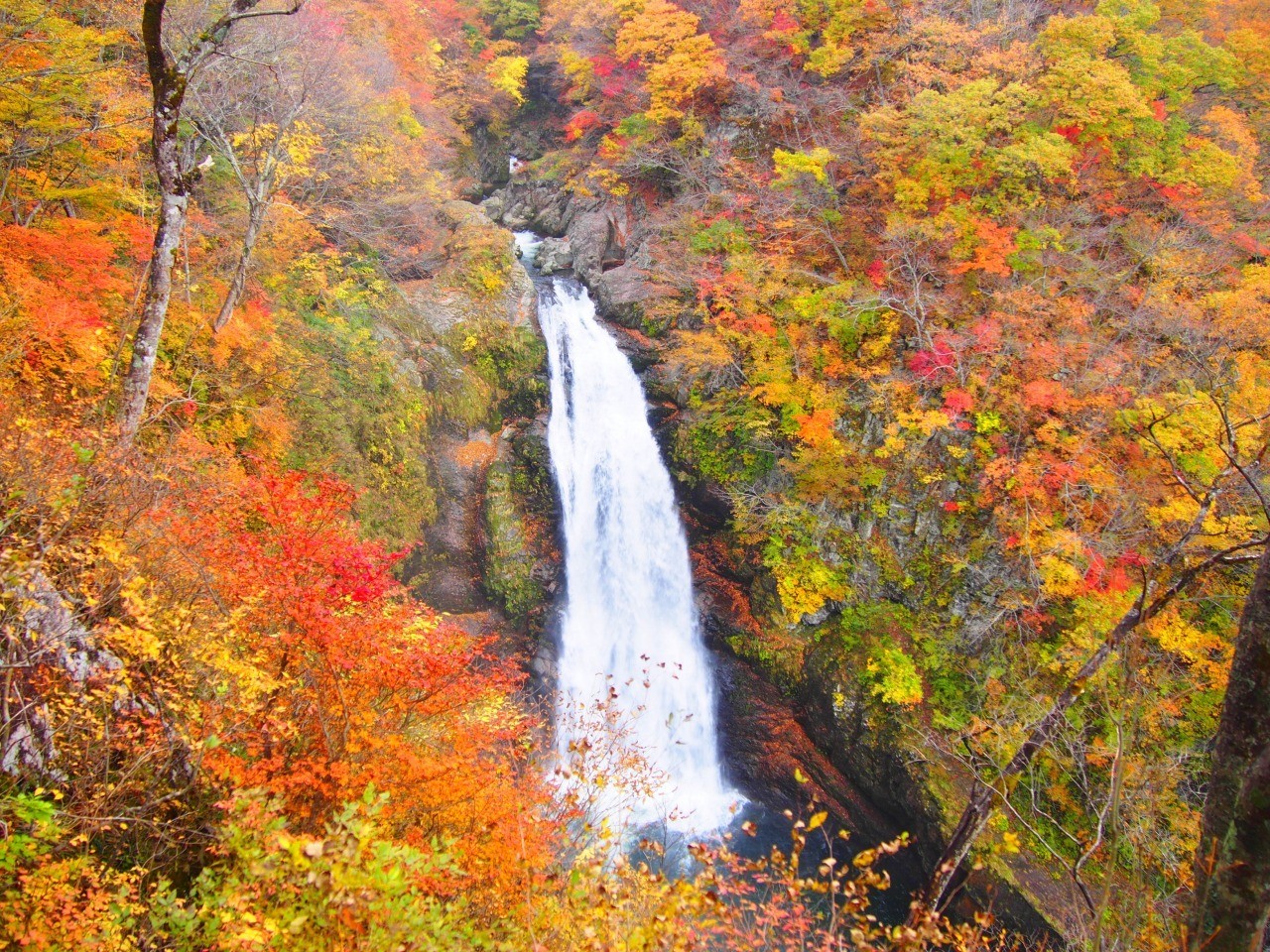
秋保大滝|東北の観光スポットを探す | 旅東北 - 東北の観光・旅行情報サイト
www.tohokukanko.jpKaminari Falls (Takayama Village, Nagano) -- 100 Meters from the Parking Lot, Behind the Waterfall in 5 Minutes
Kaminari Falls is in Takayama Village (Nagano, Japan). Exact measurements were not compiled for this guide, but the appeal of this waterfall lives in something numbers cannot capture: the ease of walking behind the falling water. Spots where you can pass behind a waterfall exist throughout Japan, but Kaminari Falls stands out for how little effort it takes to get there.
Peak seasons stretch from fresh green foliage through autumn color, with the cooling spray especially welcome in summer. The experience is simple and rewarding: about 100 meters from the parking lot, roughly 5 minutes on foot, and you are behind the falls. Because the approach is so short, even an unplanned stop delivers real satisfaction. Once you step behind the curtain of water, what hits you is not so much the visual beauty but the reverberation of sound and the wall of humidity -- the kind of sensory experience that a flat photograph simply cannot convey.
Public transit access is limited, making a car the practical choice. That said, for anyone driving through Nagano prefecture, Kaminari Falls is an exceptionally efficient side trip. For beginners, this is the waterfall that delivers the shortest walk for the most intense experience. Even travelers who dislike long trail hikes can manage it comfortably, and the novelty of standing behind a waterfall hits immediately.
Yoro Falls (Yoro, Gifu) -- A Walkable Famous Waterfall Steeped in Legend
Yoro Falls sits inside Yoro Park in Yoro (Gifu, Japan). The scale is approximately 30 meters of drop and 4 meters of width. The numbers are modest, but because you reach the waterfall naturally as part of a park stroll, the balance between classic waterfall atmosphere and comfortable walking is excellent. The site is associated with the Yoro Filial Piety Legend, adding a layer of storytelling to the scenery.
Viewing is rewarding across all four seasons: cherry blossoms in spring, fresh summer greens, cooling mist in the heat, and rich autumn foliage. The approach is the classic park-walk style, following well-maintained trails through Yoro Park. From the main parking area near the park entrance to the waterfall is about 1.2 kilometers, roughly 30 minutes on foot. Seven bridges punctuate the route, keeping the walk varied rather than monotonous. A closer parking lot is also available, cutting the walk to around 5 minutes.
By public transit, Yoro Station is about 50 minutes on foot. By car, the drive is about 10 minutes from Yoro IC, 20 minutes from Ogaki IC, or 25 minutes from Sekigahara IC. For trip planning, Yoro Falls is one of the most accessible options for families with small children or multi-generational groups. The round-trip walk from the entrance is moderate in length, but the changing scenery keeps it from feeling long. It fills the niche perfectly for travelers who want a genuine famous waterfall without steep mountain trails.
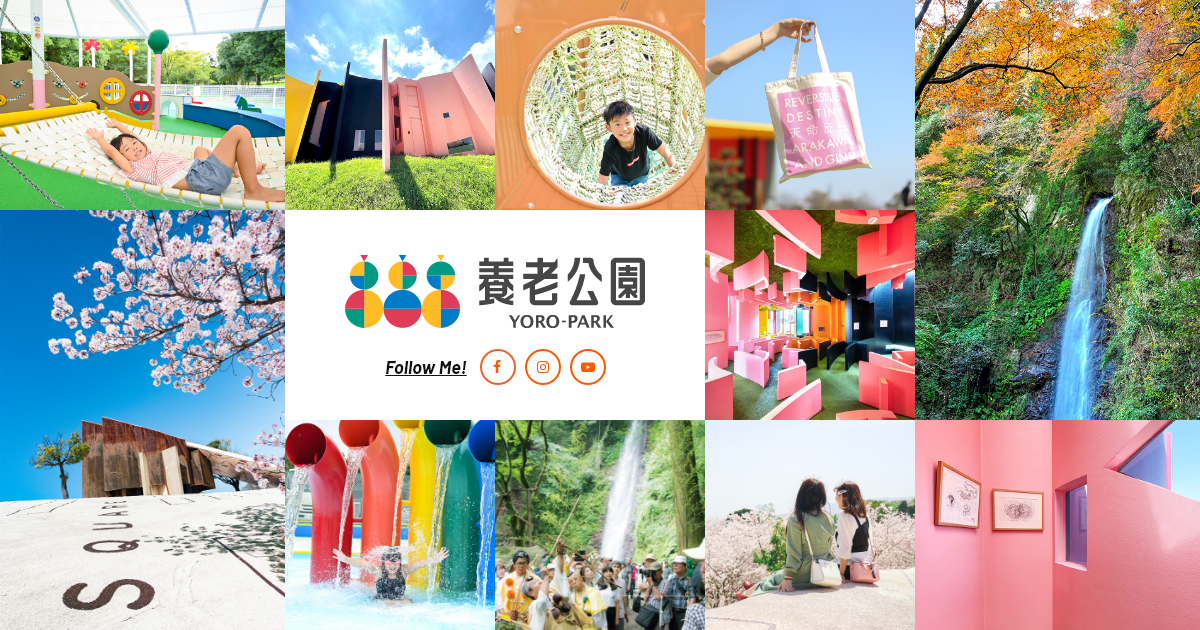
養老の滝|施設案内|養老公園(岐阜県)|アートと歴史にふれる自然の地形を生かした観光スポット
日本の滝百選に選ばれている「養老の滝」を中心に、「養老神社」や「七つの橋」など、歴史が感じられる様々な観光名所をご紹介いたします。
www.yoro-park.comChoosing a Waterfall by Travel Style
Prioritizing Power
If your goal is to be stopped in your tracks the moment you see a waterfall, Kegon Falls, Shomyo Falls, and Akiu Great Falls form the core shortlist. Kegon Falls already delivers strong vertical presence from the upper viewpoint, but descending to the observation deck brings the sound and spray rushing forward -- the waterfall feels significantly larger than the numbers suggest. The viewing experience is clear and immediate, making it a strong first pick for anyone starting their waterfall journey.
Shomyo Falls operates on a different level entirely. The 350-meter combined drop across four tiers puts it in a category of its own. Photographs and video already make it look enormous, but on-site the sensation shifts toward something like water falling out of the sky, with the cascade dominating the entire visual field rather than occupying a place within it. For anyone whose primary criterion is the sheer impact of height, this waterfall is nearly impossible to leave off the list.
Akiu Great Falls does not carry the same "national icon" reputation as Kegon or Shomyo, yet the on-the-ground impression is genuinely strong. The upper lookout provides a clean read on the overall shape, and circling down to the base brings the thunder of water and the thickness of the flow to the foreground. At approximately 55 meters of drop and 6 meters of width, the force conveyed by this direct fall exceeds what the numbers prepare you for.
Prioritizing Photography
For photography-focused visits, Shiraito Falls (Shizuoka), Manai Falls, and Fukiware Falls each offer fundamentally different subjects. Shiraito Falls (Shizuoka) centers on a horizontal curtain of water that composes well with both wide-angle and standard lenses. Because the flow consists of many thin streams rather than a single heavy column, the overall tone stays soft even in bright sunlight. Beginners frequently come away feeling they captured something genuinely appealing.
Manai Falls rewards photographers who think in terms of context. The columnar basalt of Takachiho Gorge, the river surface, and the rowboats all contribute to a single frame. Beyond the straightforward frontal shot, working in the depth of the gorge and reflections off the water opens up a wide range of compositions. Including people in the frame for scale works particularly well, and travel snapshots taken here have a tendency to look polished without much extra effort.
Fukiware Falls offers a departure from the standard waterfall-from-the-front composition. The split riverbed, the curves of the current, and the bird's-eye view from the observation deck make for interesting subjects. The circuit trail provides constantly shifting perspectives, so variety comes built into the visit. Rather than the height of the fall, the strangeness of the terrain is what makes or breaks the photographs.
Prioritizing Autumn Foliage
For autumn color combined with waterfalls, Fukuroda Falls, Fukiware Falls, and Kaminari Falls are particularly well-suited. Fukuroda Falls benefits from having built-in tiers -- the colored foliage does not simply form a backdrop but weaves into each level of the cascade. Switching between observation platforms changes the view enough that a single visit avoids feeling repetitive, and the overall quality as an autumn foliage destination is high.
Fukiware Falls offers autumn on a gorge-wide scale. From above, the scene includes not just the falls but the trees lining the trail and the flow of the river, creating genuine depth. The circuit trail lets you alternate between close-range and overhead views, suiting anyone who wants to walk through autumn color rather than photograph it from a fixed spot.
Kaminari Falls turns its close-range access into an autumn advantage as well. Rather than surveying a mountainside of color from a distance, you experience autumn leaves, spray, and rock face all layered tightly together. The short approach means you spend minimal time getting there and maximum time surrounded by the scenery.
Summer Escape from the Heat
When cooling off is the priority, Shiraito Falls (Shizuoka), Manai Falls, and Kegon Falls are the most intuitive picks. Shiraito Falls (Shizuoka) looks cool before you even feel it -- the fineness and spread of the water create a visual chill, and the surrounding air carries a gentle drop in temperature. There is no thundering roar here. Instead, simply standing nearby draws the heat out of you. The walking path is gentle enough that midsummer visits require no bracing.
Manai Falls leverages the deep shade of the gorge. The steep walls keep sunlight at bay, and the proximity to the river surface adds a layer of visible coolness. Even on a blazing day, the air inside the gorge feels noticeably calmer. Adding a boat ride brings you closer to the water and amplifies the cooling sensation -- a dimension unique to Takachiho Gorge.
Kegon Falls also works well in summer. Conversations about this waterfall tend to focus on its power, but the observation deck delivers genuine mist, and the broader Oku-Nikko area carries a lightness in the air that feels like a different climate zone when arriving from a major city. Lake Chuzenji sits at approximately 1,269 meters above sea level, and when you extend your visit to include lakeside walks, the trip expands from "seeing a waterfall" into spending time in a highland retreat.
Seeking Spiritual and Historical Depth
For travelers drawn to the prayers and stories embedded in a landscape, Nachi Falls, Yoro Falls, and Kegon Falls are the strongest candidates. Nachi Falls, as the sacred body of Hirou Shrine, carries a gravity that separates it from pure nature viewing. The sensation is less about looking up at a large waterfall and more about standing before the center of a living spiritual tradition. Visiting Kumano Nachi Taisha shrine and Seiganto-ji temple as part of the same journey deepens the impression substantially.
Yoro Falls is shaped by the Yoro Filial Piety Legend. It is not a waterfall that relies on brute force, but walking toward it through the park creates a sense of gradually entering the setting of an old story. Because it is accessible as a park stroll, the weight of the history lands without any need to brace for it.
Kegon Falls, too, shifts when viewed within the broader religious and historical context of Nikko. Lake Chuzenji, Mount Nantai, and Chuzen-ji temple form a landscape that is not merely scenic but carries traces of mountain worship. Layer that awareness onto the raw power of the waterfall itself, and the experience takes on an additional dimension.
Family-Friendly Picks
Whether a waterfall works for families often depends less on its fame and more on how clear the walking route is. On that measure, Shiraito Falls (Shizuoka), Fukuroda Falls, and Fukiware Falls stand out. Shiraito Falls (Shizuoka) offers gentle paths and soft waterside scenery that fit easily into a family itinerary with small children. The beauty of the falls is the kind that requires no explanation -- it communicates instantly.
Fukuroda Falls provides well-organized pathways to the observation platforms, and the waterfall itself delivers an immediate, legible sense of scale. Public transit access works well, with the station-to-bus-to-walk sequence straightforward enough for car-free family trips. Walking through the tunnel toward the observation deck has a hint of adventure that appeals to children.
Fukiware Falls delivers strong scenic value, but its family suitability depends on the age of the children. The circuit trail takes roughly 30 to 60 minutes, stretching to 45 to 90 minutes with photo stops, and includes stairs and uneven terrain. Active elementary-school-age children and above will enjoy it, but families relying on strollers will find it impractical.
Minimal Walking Required
For maximum reward with minimum footwork, Kaminari Falls, Shiraito Falls, and Fukuroda Falls are the most efficient options. Kaminari Falls is in a class of its own here: about 100 meters from the parking lot, roughly 5 minutes on foot, and you are standing behind a waterfall. The ratio of walking effort to experience intensity is unmatched, and it suits travelers who prefer to skip long trail hikes entirely.
Shiraito Falls (Shizuoka) keeps its demands gentle throughout. Getting to the waterfall does not drain your energy, freeing you to focus entirely on the scenery. The visual payoff is high relative to the effort, making it a natural fit as a mid-trip stop without adding fatigue to your day.
Fukuroda Falls, while not zero-effort, benefits from clear infrastructure. The route to the viewing platforms is well-defined and does not require any mountain climbing. The walk from Takimoto is manageable in length, and you collect a genuine famous-waterfall experience without excessive physical investment.
Best for Combining with Nearby Attractions
For travelers who want to build a full day rather than a single-stop visit, Kegon Falls, Nachi Falls, and Shiraito Falls (Shizuoka) are especially strong. For tips and sample routes on planning waterfall trips by public transit, the related article "10 Train-Only Travel Routes Across Japan Without a Car" is a useful companion resource.
Nachi Falls connects naturally to the Kumano Kodo pilgrimage trail network. Rather than visiting the waterfall in isolation, incorporating the Daimon-zaka stone steps, Kumano Nachi Taisha, and Seiganto-ji creates a visit where the density ramps up dramatically. The scenic sites and the pilgrimage path link organically rather than feeling like a checklist of nearby spots.
Shiraito Falls (Shizuoka) pairs naturally with Fujisan Hongu Sengen Taisha shrine. The shrine -- central to Mt. Fuji worship -- and the waterfall -- fed by groundwater from the slopes of Fuji -- share a thematic thread that ties the day together. Sengen Taisha is about 10 minutes on foot from JR Fujinomiya Station or roughly 15 minutes by car from Shin-Fuji IC, making it a practical anchor for a Fujinomiya-area circuit. The contrast between the waterfall's cool tranquility and the shrine town's activity makes for satisfying variety on a day trip.
Seasonal Guide and Visiting Tips
Fresh Green Season
Waterfalls in May and June benefit less from the water itself and more from the surrounding foliage amplifying the overall impression. Young leaves carry a softer shade of green, mosses reach peak vibrancy, and the contrast against white water resolves into clean, vivid compositions. Gorge-type waterfalls like Fukiware Falls show particularly well during this window -- the combination of damp rock faces and fresh green creates an atmosphere that looks and feels remarkably clear, both in person and in photographs.
The light cooperates, too. Midday sun has not yet hardened to its midsummer intensity, and the dappled light filtering through canopies creates gentle transitions between the bright water surface and the darker forest. Speaking from experience, waterfall visits during this season draw my attention less to the cascade's power and more to the scent of damp earth along the trail and the startling brightness of moss on stone. Waterfalls engage all the senses, sound included, but spring through early summer places the visual pleasure front and center.
One caveat: water volume is harder to predict during this period. Snowmelt and recent rainfall heavily influence how a waterfall presents itself, and the same cascade can look forceful one year and subdued the next. The fresh green season reliably delivers beautiful surroundings, but the waterfall's own performance introduces an element of chance.
Summer
July and August are when the practical value of visiting a waterfall becomes most obvious. Standing on an observation deck or a trail, the fine mist reaches your skin and body temperature drops perceptibly. Waterfalls with significant height and close-range viewing -- Kegon Falls and Akiu Great Falls among them -- tend to etch the cooling sensation into your memory. Even a horizontally oriented waterfall like Shiraito Falls (Shizuoka) generates strong visual coolness in midsummer, and simply being near water shifts your state of mind.
Reality on the ground, though, demands heat preparation. The walk from parking lot to waterfall, queuing times, and stairway or slope navigation all compound, and it is easy to arrive at the viewing platform already drained. High-traffic locations like Takachiho Gorge or waterfalls with limited observation decks become especially taxing when crowds concentrate during peak hours.
To sidestep the worst of it, mornings, evenings, and weekdays make a real difference. Morning air is still light, observation decks tend to be emptier, and you can absorb the sound and spray in relative peace. Weekdays free up shooting positions and avoid the tour-group bottlenecks that eat into the quality of a visit. Summer waterfall trips are sold as "cooling off," but in practice, the time slot you choose has as much impact on comfort as the destination itself.
Autumn Foliage
October and November add layers of color to the waterfall frame. White water, dark rock, yellows, and reds fit into a single view more naturally during this period, raising the scenic completeness of any visit. Fukuroda Falls looks especially strong in autumn -- the tiered structure means colored foliage does not merely sit behind the waterfall but integrates into each tier, making the shape of the cascade easier to read. Circuit-style waterfalls like Fukiware Falls and Yoro Falls also benefit, as the shifting angles along the walk deliver a different impression with every turn.
The complication with autumn foliage is that timing varies across the country. Altitude and latitude produce staggered peaks, so the same week in October can yield different results in highland areas versus lowland sites. Oku-Nikko, with its higher elevation, tends to turn color early, while waterfalls in southern regions or at lower elevations lag behind. Planning an autumn waterfall trip by location name alone is unreliable -- factoring in elevation and geographic position produces a better estimate.
Photography in autumn also diverges based on lighting direction. Front-lighting renders foliage colors faithfully and cleans up the waterfall's silhouette. Backlighting makes leaves translucent and can introduce light effects through spray at dawn and dusk, though exposure becomes harder to manage. Autumn waterfalls are visually rich enough that a straightforward midday visit already yields attractive results, but dialing in the time of day pushes the quality of photographs noticeably higher.
Winter and Ice Formations
December through February is when waterfalls show their most transformed faces. A place you visit to watch moving water can, depending on cold spells, become a place to gaze at frozen sculpture. Fukuroda Falls is the prime example: as ice builds up, your attention shifts from the lines of flowing water to the expanding sheets of ice clinging to the rock face. The experience is so different from standard waterfall viewing that it creates a compelling reason to revisit the same cascade across multiple seasons.
Ice formations are not guaranteed every winter. Temperature patterns and duration of cold spells determine the extent of freezing, so for waterfalls like Fukuroda Falls where ice conditions attract attention, checking the Daigo Town Tourism Association's Fukuroda Falls updates helps set realistic expectations. A scenic snowscape can coexist with a waterfall that is only partially frozen, and conversely, a sustained cold snap can make the ice itself the main event.
Winter also demands thinking about footing before scenery. Trails and observation deck surroundings where moisture accumulates freeze readily, and surfaces that look manageable can be far more slippery than they appear. In mountain areas, road icing adds another dimension -- climbing routes like the Irohazaka switchbacks in winter increases driving difficulty. Some trails close sections seasonally, and certain waterfalls impose winter access restrictions. Approaching a winter waterfall trip with summer-season assumptions about walkability is a risk best avoided.
袋田の滝 国名勝 日本三名瀑 茨城県大子町の代表的観光スポット | 大子町観光協会
日本三名瀑にも数えられ、茨城県を代表する観光スポットのひとつです。高さ120メートル、幅73メートルの大きさを誇り、滝の流れが大岩壁を四段に落下することから「四度(よど)の滝」とも呼ばれます。四季折々の美しい画像や、冬には「氷瀑」といわれる
www.daigo-kanko.jpTime of Day and Photography Tips
The time of day you visit a waterfall significantly affects your satisfaction. My first recommendation is early morning. Soft light reduces blown-out highlights on the water surface, making the individual streams easier to see with the naked eye and in photographs alike. Fewer visitors means the sound of the falls and the spread of mist are easier to take in at your own pace, and the difference is most pronounced at the busiest sites. Weekday mornings at popular observation decks are particularly comfortable.
For photography, slow shutter speeds that render flowing water as a smooth, silky stream are the classic technique. An ND filter helps achieve slower speeds even in daylight, while a polarizing filter cuts reflections and tames the sheen on wet leaves. Waterfalls produce stark differences between bright and dark areas, so shooting on auto tends to blow out the water or plunge the surrounding forest into shadow.
Where morning or evening sidelight enters the scene, mist can catch the rays and produce visible light shafts. Narrow gorge openings and cave-like formations produce dramatic beams as well, but these conditions are limited to specific seasons and times of day. Pursuing them requires more than just clear skies -- the sun's angle, the orientation of the valley, and the day's water volume all play a role. The most striking single image usually owes more to advance research than to luck.
💡 Tip
Early mornings offer soft light along with emptier observation decks and trails, which means long-exposure compositions are easier to set up without interruption. At popular waterfalls, "what time you arrive" often matters more than "what season you visit."
Safety and Checking Current Conditions
The universal truth about waterfall environments is that surfaces stay wet almost constantly. Even on clear days, spray reaches farther than you might expect, and rocks, boardwalks, stone steps, and tunnel exits are all prone to becoming slippery. On trails like the Fukiware Gorge circuit, where uneven steps and narrow sections appear throughout, the visual distraction of the scenery makes it easy to forget how unstable the footing can be. Waterfall sites feel open and inviting, but the terrain underfoot changes more abruptly than a beach.
After rainfall, the risk level rises sharply. Increased water volume from the previous day or the day itself can add force to sections that are normally calm, and spray makes walkways even slicker. Trail closures and restricted viewing areas are not uncommon in these conditions, and signs indicating rockfall risk or no-entry zones should be followed at face value. Gorge-type waterfalls and valley-side trails see the biggest changes.
Winter adds freezing on top of everything else. Even well-maintained tourist waterfalls may close sections of their trails for the season, and road conditions on approach routes can shift. For destinations like Akiu Great Falls, Fukiware Falls, and the Oku-Nikko corridor, factoring in road status alongside on-site opening information changes how you plan the trip. Waterfalls are natural landscapes, and the peak of their visual drama does not always coincide with the safest conditions -- keeping that premise in mind makes for better decisions.
Gear, Clothing, and Safety Essentials for Waterfall Trips in Japan
Clothing and Footwear
Footwear is the single most impactful gear decision for waterfall visits. The minimum standard is sneakers or above, ideally with soles that grip on wet surfaces. The area around a waterfall is often damp even on sunny days, and stone steps, boardwalks, and exposed rock catch your feet more than they appear to. Sandals lack the traction to recover from a slip, and leather shoes become miserable once wet, so even on a sightseeing-focused day, choosing the right shoes keeps the entire itinerary stable.
Clothing does not need to reach full hiking-gear level, but staying mobile even when damp should be the guiding principle. Gorge environments feel cooler than the ambient temperature suggests, and observation decks where mist lands bring body temperature down further. From experience, quick-drying synthetic tops and pants outperform heavy cotton by a wide margin. Even in summer, valley trails can feel chilly, while the walking stretches to reach a waterfall generate sweat -- layering for easy adjustment is what ends up feeling most natural.
Rain preparation also works better when it keeps your hands free. Umbrellas on a waterfall trail leave one hand occupied, which delays your reaction to uneven footing. A rain jacket -- ideally as a full top-and-bottom set -- is the more practical choice. Even in light drizzle during a viewing session, having both hands available makes a noticeable difference in confidence. A hat serves double duty: blocking sun and softening the impact of light rain or contact with overhanging branches.
Useful Items to Bring
Packing does not need to be elaborate, but waterfall trips involve overlapping doses of "a bit wet," "a bit dirty," and "a bit more walking than expected" -- so a few targeted additions to a standard sightseeing kit pay off. The three items with the best return are a quick-dry towel, a waterproof bag, and a spare pair of socks. Swapping socks alone cuts discomfort dramatically, and a waterproof bag removes the panic of protecting your phone and wallet. At gorge walks and boat-ride spots, these three items prove especially valuable.
Insect repellent is worth adding in summer. While gorge areas sometimes catch a breeze, sections dense with vegetation and close to water attract bugs, and their presence grows toward evening. Carrying repellent lets you watch the scenery in peace, and pairing it with clothing that does not leave too much skin exposed makes the combination even more effective. Sunscreen and a hat also belong in the kit. Waterfalls carry a reputation for coolness, but the approach routes from parking lots and open observation areas expose you to full sun.
A small investment in connectivity preparation also helps. Mountain areas and gorges can drop cell signal, which breaks the assumption that your map app will be available on demand. Offline maps remove the anxiety of uncertain navigation, and on a day heavy with photo-taking and GPS use, a portable battery keeps everything running. Finally, some smaller parking lots, shops, and facilities in waterfall areas still operate on cash, so having small change on hand prevents the flow of your day from stalling over a payment issue.
ℹ️ Note
Waterfall trip packing works best when the goal is "nothing is ruined if it gets wet" rather than "heavy-duty gear." Dividing the inside of your bag with small waterproof pouches makes towels, phone, and wallet easy to access and reduces fumbling on observation decks.
Safety and Etiquette
The important thing to internalize about waterfall environments is that hazards are not confined to dramatic spots. Even at well-maintained tourist waterfalls, slippery surfaces appear in mundane places: bridge joints, the edges of stone paths, moss-covered rocks, and the floor immediately after exiting a tunnel. The moment you step sideways for a better photo angle is often the most dangerous moment, so prioritizing stable footing over the perfect position actually lets you enjoy the scenery with less tension.
After rain, the landscape gains intensity, but so does the need for caution. Post-rain water surges can raise trail difficulty sharply, and sections that are normally open sometimes close without much notice. No-entry signs, trail barriers, and safety ropes are best taken literally rather than treated as suggestions. A waterfall swollen with rainwater is spectacular to watch, but spectacle and safety do not scale together.
At the planning stage, resisting the pull of remote or off-trail waterfalls also improves your success rate. The deeper your interest in waterfalls grows, the more appealing "the one nobody visits" becomes, but for your first several outings, waterfalls with established infrastructure deliver better results. Parking lots, maintained trails, observation decks, and signage all create space for you to focus on the experience rather than logistics. Boots-and-bushwhack waterfalls reward accumulated experience -- save them for later, and the payoff will be greater.
On the etiquette side, the principle of "yield quietly" goes a long way in nature-viewing settings. Avoiding extended occupation of observation decks, giving way on narrow trails, and respecting the boundaries around wet rock areas are basics that collectively shape the atmosphere for everyone. At waterfalls that overlap with sacred sites, like Nachi Falls, being mindful that you are in a space of worship as much as a scenic overlook helps you move through naturally and without friction.
Choosing Your First Waterfall in Japan
Trip satisfaction depends less on a waterfall's fame and more on whether your transportation method and the kind of scenery you want actually align. To choose your first waterfall, start by deciding between public transit and car, then layer in the season -- and the shortlist takes shape quickly. Picking one of the classic Three Great Waterfalls or opting for a gorge walk or a cooling summer stop are all valid starting points. When in doubt, begin with a waterfall that is easy to reach and will not leave you scrambling on-site. That approach is the surest path to enjoying the trip.
Related Articles
15 Best Regional Food Destinations in Japan: Local Specialties by Prefecture
When researching what to eat on a trip to Japan, terms like gotouchi gourmet, kyodo ryori, and meibutsu ryori can blur together, making it hard to pick a destination. This guide sorts out those distinctions using official sources such as the Ministry of Agriculture's regional cuisine database, Japan Tourism Agency statistics, and B-1 Grand Prix data, then narrows the field to 15 prefectures for easy trip planning.
10 Hidden Natural Gems in Shikoku, Japan — Chosen for Scenery and Serenity
Planning a quiet nature-focused trip through Shikoku? Rather than defaulting to the usual tourist spots, seek out places where you can actually slow down and take in the landscape. Coverage note: the author visited and verified these spots between February and March 2026 (checking official sources for the latest info is always recommended).
10 Best Solo Onsen Trips in Japan: Quiet Inns Where You Can Truly Unwind
A satisfying solo onsen trip in Japan comes down to choosing an inn that matches how you want to spend your time, rather than chasing famous hot spring resort names. Narrow your search by room count, dining style, private baths or in-room open-air baths, solo-traveler friendliness, access, and budget, and strong candidates become remarkably clear.
15 Hidden Scenic Spots in Japan That Locals Actually Recommend
Tired of crowded observation decks and the same postcard views? This guide pulls together 15 lesser-known landscapes across Japan where the quiet still lingers, complete with best seasons, ideal timing, and practical access details.