
12 Hidden Autumn Foliage Spots in Japan: Beat the Crowds with Timing and Access Tips
12 Hidden Autumn Foliage Spots in Japan: Beat the Crowds with Timing and Access Tips
Want to enjoy koyo (autumn foliage) without fighting through packed tourist sites? This guide narrows it down to 12 quieter spots across Kanto and Kansai, starting with a comparison table so you can zero in on the right fit fast.
Iconic autumn foliage sites draw you in with their brilliance, but the shoulder-to-shoulder crowds can drain the magic fast. This guide cuts through the noise with 12 spots across Japan's Kanto and Kansai regions that stay quieter than the blockbuster destinations, presented in a comparison table first so the full picture clicks before you dive into details. Before jumping to specific locations, we cover the difference between red and yellow autumn leaves, why peak timing shifts with region and elevation, and how to think about viewing windows rather than single "best days." If you are planning a trip to Japan during autumn, understanding these basics will sharpen every decision you make about where and when to go. Peak foliage is not something you pin to one date. Reading it as a range is the approach that actually works. Factor in the day of the week, time of day, your route order, and even how you use front-light, back-light, and side-light for photos, and your 2026 koyo trip becomes both quieter and more photogenic.
What to Know Before Picking a Koyo Hidden Gem
Red Leaves vs. Yellow Leaves
The Japanese word koyo (autumn foliage) is often associated with red maples, but it actually covers the full spectrum of color change in deciduous broadleaf trees before they drop their leaves: reds, yellows, and browns all at once. When you look up at an autumn mountainside in Japan, deep-red momiji (Japanese maple) and soft golden ginkgo stand side by side as part of the same seasonal shift.
The color difference comes down to which pigment takes center stage. Yellow foliage (ouyou) appears when chlorophyll breaks down and carotenoids that were already in the leaf become visible. Red foliage (kouyou in the narrow sense) happens when anthocyanins are newly produced, triggered by dropping temperatures. Scientific overviews from Fukuoka Prefecture's biodiversity resources and the BuNa science platform both confirm this as the underlying mechanism.
Knowing the distinction sharpens your search. If you want the moody reds of a temple garden, that points you toward one set of spots. If a golden ginkgo-lined avenue in an urban park sounds better, the destination and ideal time of day shift accordingly. In this article, hidden gem does not just mean "a place nobody has heard of." It means a place where crowds thin out relative to major tourist magnets, where visitors naturally spread across the grounds, and where the access conditions themselves help keep things calm.
Viewing Windows and Year-to-Year Variation
Trying to hit peak foliage on one specific day is a losing game. The cycle from early coloring to leaf drop spans roughly one month, and the sweet spot of peak beauty usually lands around 20 to 25 days after coloring begins. Think of "peak" as a band, not a point, and you are far less likely to miss it.
Why does that band shift every year? Weather. The conditions that produce vivid color are ample sunlight, a sharp temperature gap between day and night, limited rain, and moderate humidity. Crisp mornings, sunny afternoons, and stretches without heavy rain tend to produce leaves with real punch. In a year where warmth lingers or rain comes in waves, coloring may progress slowly and saturation can shift.
On multiple reporting trips, I have watched the same spot look pale just after it entered the "typical peak window," then transform dramatically a few days later. That is why hidden-gem hunting is not just about popularity. It is about how much room each spot gives you to work the viewing window. Large parks, trails with elevation changes, and lakeside slopes all create variation within a single visit, so "right now, this part looks great" is easier to find.
💡 Tip
Early morning through mid-morning is a sweet spot. Crowds are lighter, and low-angle light brings out the three-dimensional texture of leaves. Front-lit scenes show color faithfully, while back-lit leaves reveal their veins. The same tree looks like two different subjects.
Why Region and Elevation Create Timing Gaps
The autumn color front appears to sweep from north to south across Japan because temperatures drop earlier in the north. Broadly, Hokkaido and the Hokuriku coast kick off the season in early October, while lowland areas of Kanto and Kyushu reach their stride from mid-November into mid-December. Within a single prefecture, mountaintops color up well ahead of flatlands and city streets, simply because higher elevation means cooler temperatures sooner.
This is practical knowledge for trip planning. A mountain drive route with significant elevation change colors from the top down, stretching the viewing band. A flat city park or tree-lined avenue, on the other hand, tends to peak in a tighter cluster, making the timing hit-or-miss. Knowing the gap between neighboring spots at different altitudes lets you shift attention to quieter alternatives just before or after the big-name sites peak. Lakeshores, gorges, temples, and urban parks within the same prefecture can look completely different on the same weekend, so go beyond area names and look at what elevation and terrain shape each spot sits at.
Where to Check 2026 Peak Forecasts
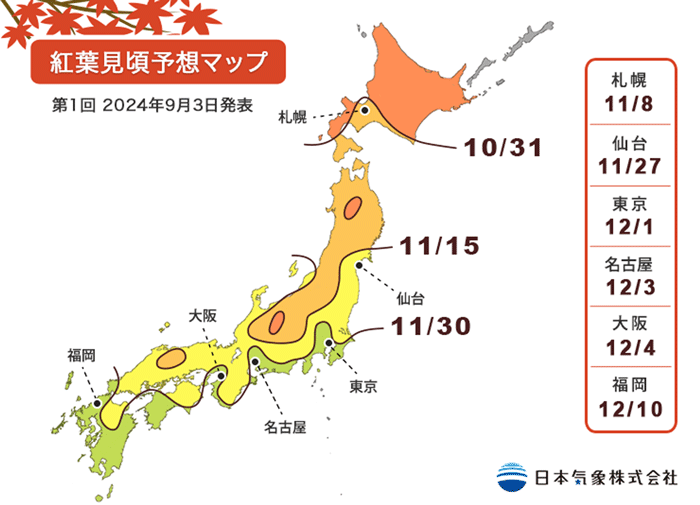
To track 2026 timing, you need sources that update frequently and cover enough locations to surface less obvious candidates. For nationwide baseline data, Japan Weather Corporation's foliage forecast is solid, covering roughly 700 spots plus about 2,900 mountains. The mountain data is especially useful for finding hidden gems that flat-land-focused lists miss. Their methodology is outlined on Japan Weather Corporation's koyo forecast page.
For daily weather context alongside foliage updates, tenki.jp's autumn color and weather page is a clean resource. The 2025 season is wrapped, and 2026 data typically starts populating around September. Seeing temperature trends next to foliage status makes it straightforward to catch deviations from the historical average.
For sheer volume of listed spots, Walkerplus's koyo information covers about 1,200 locations nationwide, pulling in parks, gorges, and temples that get buried on shorter lists. Use Walkerplus when you want a wide net, Japan Weather Corporation when you need mountain-level timing, and tenki.jp when you want weather side-by-side. That three-source setup handles the year-to-year variation of 2026 well.
2025年紅葉・黄葉見頃予想(第3回)を発表| ニュース | 日本気象株式会社
Earth Communication Providerとして、気象予測、大気環境調査、シミュレーションなど様々な技術をもって、全国に幅広く活動を行っています。24時間365日休むことなく空・海・大地の変化に注意を払い、人々のかけがえのない
n-kishou.com12 Less-Crowded Koyo Spots at a Glance
Comparison Table
Getting the full picture first makes narrowing down easier. Below, 12 spots that are comparatively easier to enjoy without heavy crowds are lined up by region, viewing window, access, and estimated walking time. As noted earlier, peak foliage works best as a range, and lakeside, mountain, and urban park peaks can shift even within the same weekend.
| Spot | Region / Prefecture | Type | Typical Viewing Window | Main Access | Walk Time Estimate | Best Times to Avoid Crowds | Trip Style |
|---|---|---|---|---|---|---|---|
| Shinsei-ko (Lake Shinsei) | Kanto / Kanagawa | Lake / Valley | Around November | Public transit / Car | ~20 min | Weekday mornings / Weekend early AM | 🚃 🚗 ◐ ☀ |
| Isehara City Sports Park | Kanto / Kanagawa | Park | Around November | Public transit / Car | 45 min - 1 hr | Weekday mornings / Near closing | 🚃 ◐ ☀ |
| Horen-ji Temple | Kanto / Kanagawa | Temple | Around November | Public transit / Car | 30 min - 1 hr | Weekday mornings | 🚃 ◐ |
| Kameyama-ko (Lake Kameyama) | Kanto / Chiba | Lake / Valley | Mid-Nov - Early Dec | Public transit / Car | 2 - 3 hrs | Weekday mornings / Weekend early AM | 🚃 🚗 ☀ |
| Kaore Valley | Tokai / Gifu (Seki City) | Lake / Valley | Late Oct - Early Nov | Car | ~1 hr | Weekday mornings / Weekend early AM | 🚗 ◐ ☀ |
| Ankoku-ji Temple (Tajima Ankoku Zen-ji) | Kansai / Hyogo | Temple | Mid-November | Car | 20 - 45 min | Morning on open days | 🚗 ◐ |
| Daitoku-ji (Ushitaki-san) | Kansai / Osaka | Temple | Around November | Public transit / Car | 45 min - 1 hr | Weekday mornings / Weekend early AM | 🚗 ◐ ☀ |
| Osaka Castle Park | Kansai / Osaka | Park | Early Nov - Early Dec | Public transit | 1 - 2 hrs | Weekday mornings / Late afternoon | 🚃 ◐ ☀ |
| Kyoto Sento Imperial Palace | Kansai / Kyoto | Temple / Garden | Around November | Public transit | ~1 hr | Morning sessions | 🚃 ◐ |
| Hieizan Driveway | Kansai / Kyoto-Shiga border | Scenic drive / Mountain | Late Oct - Mid-Nov | Car | 2 - 3 hrs | Early morning - late morning | 🚗 ☀ |
| Mt. Ibuki Area | Kansai / Shiga | Scenic / Mountain | Late Oct - Around Nov | Car | 2 - 3 hrs | Morning / Late afternoon | 🚗 ☀ |
| Metasequoia Avenue | Kansai / Shiga | Park / Avenue | Late Nov - Early Dec | Car / Public transit | 1 - 2 hrs | Early morning / Weekday mornings | 🚗 ☀ |
Even from the table alone, clusters stand out. If you prefer public transit and quiet walks, Shinsei-ko, Horen-ji, and Kyoto Sento Imperial Palace surface first. If you want to cover big scenery by car, Hieizan Driveway, Mt. Ibuki Area, and Kaore Valley are strong matches. In my experience, lakeside spots encourage you to slow your pace, while mountain routes open the view so dramatically that even a short stop feels like a full trip.
⚠️ Warning
A reliable rule for dodging crowds across all seasons: weekday mornings, early morning on weekends, or the last 1-2 hours before a park or facility closes. At autumn foliage sites, this single habit makes a tangible difference in how calm the experience feels.
Icon Legend
The icons in the table are shorthand for how to shape your trip. They indicate whether public transit works well, whether a car gives you more flexibility, and whether the spot fits a half-day outing or a full day trip.
- 🚃 Public transit friendly
- 🚗 Car recommended
- ◐ Half-day outing
- ☀ Full day trip
Public transit friendly means the connection from the nearest station or bus stop is relatively easy to navigate. Shinsei-ko wraps up neatly as a light walk, and Horen-ji is reachable by bus for a quiet temple visit. Urban parks like Osaka Castle Park sit right at station exits, keeping travel effort low.
Car recommended applies where mountain terrain, elevation changes, or the ability to link nearby stops becomes the real advantage. Hieizan Driveway uses the elevation itself to widen the foliage window, and Mt. Ibuki Area pairs panoramic views with autumn color in a way that works best on wheels. Kaore Valley and Ankoku-ji also fall into the category where driving simplifies the logistics.
Half-day spots keep on-site time compact. Ankoku-ji, for instance, centers on the dodan-tsutsuji (enkianthus) viewed through the temple's shoji screens, giving the visit a focused core. Shinsei-ko loops in about 20 minutes, easy to wrap up even with photo stops. By contrast, Lake Kameyama, Hieizan Driveway, and Mt. Ibuki Area are better planned as full-day outings once you factor in travel and side stops.
Characteristics by Type
Looking at the 12 spots through the lens of timing reveals useful patterns. Lake and valley types tend to hold their color deep into late autumn. Lake Kameyama stretches from mid-November into early December, and since you can walk from the station to the lakeshore, it shapes up well as a quiet day trip. My own approach would be to catch the shore colors in the morning and add a sightseeing boat for a 2-3 hour visit. Kaore Valley peaks earlier, from late October into early November, when the mountain air thickens and the gorge scenery gets intense in a short walk. Shinsei-ko asks very little of your body, making it the right pick for a day when you just want a small dose of nature.
Mountain and scenic drive types use elevation differences to layer the color. Hieizan Driveway colors from the top down, so shifting your position on the same day lets you chase "the best spot right now." Mt. Ibuki Area adds the appeal of combining autumn color with sunset views. Rather than isolating foliage, think of it as folding the sky into the trip. Mountain routes naturally spread visitors out, and the clarity of morning air translates directly into image quality.
Urban park types offer the advantage of dispersal even at well-known locations. Osaka Castle Park is easy to reach by train, but the points of interest extend along outer paths and tree-lined avenues rather than funneling into one gate like a famous temple. Ginkgo yellows take center stage here, a different feel from the red maple focus of mountain temples. Isehara City Sports Park and Metasequoia Avenue also reward you with "surface-level" scenery, meaning a slight shift in position opens up a calmer frame.
Temple types stand out for the clarity of their quiet. Horen-ji and Daitoku-ji blend mountain air with temple grounds, and the appeal is more about lingering impression than spectacle. Ankoku-ji concentrates the eye on a single framed view through the main hall, so even a brief stay prints itself in memory. Kyoto Sento Imperial Palace, with its capacity-controlled access, is a useful category to remember: places where the entry system itself keeps density down.
If you are stuck choosing, hold onto three principles: lakes stretch into late autumn, mountains use elevation to extend the window, and urban parks spread people out. Layer in the stillness of temples and the decision map for "photo day," "half-day walk," or "scenic drive linking multiple views" comes into focus naturally.
The 12 Hidden Koyo Spots in Detail
Kanagawa | Shinsei-ko, Lake Shinsei (Hadano City): A 20-Minute Loop with Beautiful Reflections
The official name is Shinsei-ko (Lake Shinsei), located in Imaiizumi, Hadano City, Kanagawa Prefecture, Japan. The typical viewing window is around November, when colored trees mirroring off the lake surface create a quiet kind of brilliance. This is not the flashy spectacle of a major landmark. It is a place where the scenery shifts gently as you walk.
Access works well by both public transit and car, and the lake connects naturally to wider Hadano-area walks. Drivers will find the surrounding roads straightforward, with parking available. Capacity and fee details can shift seasonally, so plan around on-site signage. The loop is about 20 minutes around the lake, and the path is gentle enough for families with small children or elderly companions. Even with photo stops, a 30-minute to one-hour stay fits comfortably.
What makes it a hidden gem is the scale. You step right into the visual core on arrival, yet visitors do not bottleneck at a single point. There is no queue-at-the-gate feeling you get at famous mountain temples or blockbuster gorges. You set your own pace along the shore. Best for half-day nature seekers, those who want easy walking, and anyone drawn to reflection photography.
For the calmest experience, weekday mornings are the strongest match. The lake surface settles, light stays soft, and you can photograph the water colors before harsh angles set in. Weekend early mornings work too. Special lighting events or illuminations may vary by year, so check the Hadano-area tourism resources for the current season. The surrounding area has dining options and side stops that fold into a half-day trip around the Hadano-Tanzawa corridor.
Kanagawa | Isehara City Sports Park: Easy Access, Easy Walking
The official name is Isehara City Sports Park, located in Nishi-Tomioka, Isehara City, Kanagawa Prefecture, Japan. The viewing window is around November, with yellow and red foliage lining the park paths against the kind of open sightlines a sports park naturally offers. Compared to deep mountain sites, the footing here is reassuring. Koyo as an extension of a morning walk.
Public transit access runs through Odakyu Line Isehara Station North Exit, then about 10 minutes by bus. Driving is also straightforward, with parking available, making it practical for families or anyone carrying gear. Fee and usage details follow the facility's standard policies. Walkability ranks near the top of these 12 spots. Paths are well-maintained and manageable with strollers or for elderly visitors. Plan 45 minutes to 1 hour for a relaxed loop with photos and rest stops.
The hidden-gem quality comes from how foot traffic disperses. Athletic facilities and open fields draw some visitors away from the foliage paths, so the "everyone packed into one corridor" pressure of a famous temple does not build up here. Best for public transit users who want an easy trip, families prioritizing walkability, and anyone looking for a low-key foliage outing.
To dodge crowds, avoid the core leisure hours. Weekday mornings are the obvious play, but even on weekends, arriving near opening or visiting in the late afternoon keeps things manageable and reduces parking waits. The gentle terrain suits photography and simple strolling equally. Linking the visit with lunch in Isehara City or a side trip to a day-use bath in the Oyama direction rounds out a comfortable day.
Kanagawa | Horen-ji Temple (Hadano City): Mountain Quiet in a Temple Setting
The official name is Horen-ji Temple, located in Kita-Yana, Hadano City, Kanagawa Prefecture, Japan. The viewing window is around November, when reds and yellows seep into the mountain air surrounding the temple. The atmosphere settles even before you start walking. This is a place for people who want lingering impression over spectacle.
Public transit access goes through Hadano Station North Exit, then about 25 minutes by bus. You can also drive. Parking availability follows temple operations, which may shift around events or seasons. The grounds themselves keep things contained, so 30 minutes to 1 hour covers a visit without rushing. Stone steps and grade changes are part of temple architecture here, so wear shoes with grip. Families with very young children or elderly visitors should plan for a slow, steady pace through the grounds.
The hidden-gem factor comes from the extra step in access. That one additional transfer keeps the flood of casual visitors at bay. There is none of the photo-queue pressure you feel at famous autumn temples. You can absorb not just the color but the sounds of the grounds. Best for solo travelers seeking quiet temple visits by public transit, those who want to reset mentally in a short window, and anyone actively avoiding noise.
Weekday mornings deliver the most reliable calm. On weekends, sidestepping the hours that overlap with services or worship traffic helps. Evening openings or illumination events vary heavily by temple and year, so treat this as a daytime-first destination. Linking with dining in Hadano or a stop in the Tanzawa direction creates a half-day itinerary with real density.
Chiba | Lake Kameyama (Kimitsu City): Late-Autumn Lakeside, Great for Drivers
The official name is Kameyama-ko (Lake Kameyama, the reservoir behind Kameyama Dam), located in Kimitsu City, Chiba Prefecture, Japan. The viewing window is mid-November through early December, which is a genuine advantage. Many autumn spots finish their run in the first half of November, but this lakeside stays viable into late autumn, giving you flexibility to reschedule without losing the trip. If you are considering combining autumn foliage with a hot spring soak, our related article on recommended day-trip onsen with scenic open-air baths may be useful.
Gifu | Kaore Valley (Seki City, Itadori): A Gorge Walk Wrapped in the Sound of Water
The official name is Kaore Keikoku (Kaore Valley), located in Itadori, Seki City, Gifu Prefecture, Japan, consistent with Seki City tourism pages and the official Gifu Prefecture tourism portal. The viewing window is late October through early November, when autumn color layered against the steep gorge walls makes the blue-green water and pale rock faces stand out even more sharply.
What keeps this place uncrowded is that the scenery quality outpaces the access convenience. Fewer people push in, leaving room to immerse yourself in the sound of the water. Views from the bridge and cliff-edge vantage points open dramatically, packing a lot of impact into a short visit. Best for drivers, gorge photography enthusiasts, and anyone seeking the intensity of quiet natural scenery.
Weekday mornings are the safest bet for solitude, and early weekend hours work too. Wet weather raises the stakes underfoot. Trail conditions can change with the season or construction, and there does not appear to be a regular illumination program. Combining the visit with Itadori River onsen or nearby restaurants turns the trip into a full day that goes well beyond foliage alone.
Osaka | Ushitaki-san Daitoku-ji Temple (Kishiwada City): Deep Mountain-Temple Reds, Bus + 3-Minute Walk
The official name is Ushitaki-san Daitoku-ji Temple, located in Osawa-cho, Kishiwada City, Osaka Prefecture, Japan. The viewing window is around November, when the mountain temple produces rich, saturated reds that feel out of proportion to how close it sits to the city. Trees enclose the approach path and the temple buildings, and the chill in the air registers as distinctly autumn in a way that urban neighborhoods do not.
Driving is the most convenient access: about 20 minutes from the Kishiwada-Izumi IC. Public transit also works, with a bus stop roughly 3 minutes on foot from the entrance, which is one of this spot's quiet advantages. Parking is available. The terrain involves stone steps and slopes typical of mountain temples, so the walkability sits at "not effortless but not demanding." Plan 45 minutes to 1 hour for a comfortable visit. Families with children can focus on the main temple grounds, and elderly visitors do well sticking to the less steep sections.
The hidden-gem logic is simple: when people in Osaka think autumn foliage, they gravitate toward city parks and marquee temples, leaving this mountain temple with proportionally fewer visitors. Yet it remains reachable by bus, so you do not need a car to find a quiet setting. Best for temple enthusiasts, those who want mountain-framed foliage, public transit users looking to leave the city center, and drivers building a scenic route.
For crowd avoidance, weekday mornings or early weekend hours make the biggest difference. Midday tends to draw local drivers for short outings, so hitting Daitoku-ji first and then heading back toward Kishiwada for lunch creates a natural flow. Illumination or special viewing events shift year to year, so the daytime temple colors are the main draw. Pairing the visit with nearby onsen or dining spots lets the mountain-temple quiet and day-trip ease coexist well.
Osaka | Osaka Castle Park (Osaka City): A Large Urban Park Where Crowds Thin Out
The official name is Osaka Castle Park, located in Chuo-ku, Osaka City, Osaka Prefecture, Japan. The viewing window is early November through early December, with both momiji reds and ginkgo yellows sharing center stage. Urban park foliage carries a "too crowded" reputation, but this park is large enough, with enough open sightlines, that route choice alone can carve out genuinely calm stretches.
Access is excellent, with multiple JR and subway stations putting you on foot into the park. Parking exists but public transit is the natural fit here. Walkability is high: maintained paths dominate, and the park works well for strollers and elderly visitors. Budget 1 to 2 hours to cover ginkgo avenues and moat-side views at a comfortable pace.
In hidden-gem terms, this is not "unknown" but rather "famous yet dispersible." Unlike a top-tier temple with a single queue line, the points of interest spread across outer paths and tree-lined routes, giving you control over what you see and where you stand. Best for access-first planners, families, first-time autumn strollers, and anyone who prefers to skip stairs.
For timing, weekday mornings or the late-afternoon window when commuter and tourist peaks do not overlap work well. Entrances closest to stations attract the most foot traffic, so starting your walk a bit further in before pulling out the camera changes the feel noticeably. Evening events and illuminations follow event-specific schedules that shift annually. Restaurants and cafes in central Osaka sit minutes away, and the predictability of transit times is another strength of this park.
Shiga-Kyoto | Hieizan Driveway: Elevation Changes Stretch the Season
The official name is Hieizan Driveway, spanning the Mt. Hiei area across Otsu City, Shiga Prefecture, and Sakyo-ku, Kyoto City, Japan. The viewing window is late October through mid-November, and the elevation difference means coloring shifts along the route. Move to a different altitude on the same day and the scenery resets. Autumn advances from the summit downward, creating a layered effect where "peak" is always somewhere on the mountain.
Access is car-based. The trip is structured around linking observation decks and rest stops, so the driving itself becomes part of the viewing experience. Parking areas dot the route, though capacity and fee structures vary by facility. Walkability depends on the specific stop; lookout areas tend to be accessible, while some points involve stairs or slopes. Plan 2 to 3 hours, and families with children or elderly travelers can keep things comfortable by focusing on the observation spots.
The hidden-gem argument here is that Kyoto's downtown temples absorb the foliage crowds, while Mt. Hiei disperses visitors across a driving route that non-drivers rarely attempt. Traffic reputation alone scares some people off, but arriving in the morning keeps things noticeably quieter than the scenery would suggest. Best for drivers, panoramic-view seekers, and anyone who wants multiple vantage points in a short span.
Early morning through late morning is clearly the best window for crowd avoidance. Midday traffic on the mountain road can slow considerably, so front-loading the scenic stops and descending for lunch or an onsen afterward organizes the day well. Evening events and lighting follow event-specific calendars, so plan around daytime views as the main draw. The scenery differs between the Lake Biwa side and the Kyoto side, giving the same road variety that keeps it engaging throughout.
Shiga | Mt. Ibuki Area: Chasing Sunset and Autumn Color Together
The spot is presented as the Mt. Ibuki Area, centered around Maibara City, Shiga Prefecture, Japan and covering the foliage from the mountain's base up to its lookout points. The viewing window is late October through around November, and the mountain's scale combines with sky color during the golden-hour stretch to powerful effect. When late-afternoon light hits at an angle, the topography itself becomes part of the impression, not just the leaves.
Access is car-oriented. Separating the walking portions from the drive-and-view portions keeps the day manageable. Parking is available at various stop points. The terrain is not uniformly flat, and wind exposure can be noticeable in places, so families with small children and elderly visitors do best with short, view-focused segments. Budget 2 to 3 hours to cover driving, walking, and photography at a relaxed pace.
This area stays under the radar because Kansai's autumn crowds concentrate on temples, and relatively few people make the trip to frame a whole mountain as their foliage destination. The mountain-wide perspective means visitors do not cluster at a single point, and compositions for photography come easily. Best for panoramic-view enthusiasts, photography-focused travelers, and anyone who wants the day's final hours to be visually memorable.
Crowd avoidance starts with clear morning air, but Mt. Ibuki also rewards late afternoon visits. Cutting it too close to sunset creates parking and navigation pressure, so arriving at the lookout a bit early lets you track the color transition at a comfortable pace. This is not an illumination destination. It is a natural-light destination, and framing it that way sharpens its appeal. Maibara and Nagahama offer dining and day-use baths nearby, giving the end of the trip a gentle buffer.
Saitama | Nagatoro (Chichibu District): Illumination-Friendly, with Scattered Viewing Points
The official name is Nagatoro, located in Nagatoro Town, Chichibu District, Saitama Prefecture, Japan. The viewing window is around November, and the appeal spreads across the gorge, the area around Tsuki-no-Ishi Momiji Park, and the Hodosan direction. Rather than a single concentrated spot, Nagatoro works as a zone with multiple foliage nodes. It has name recognition as a foliage destination, but the real strength is that smart routing still finds you quiet pockets.
Access works by Chichibu Railway or by car, and you can start walking right from the station area. Parking exists but congestion varies by timing and location across the area. Riverside walks are relatively gentle, though stairs and uneven terrain show up in places. For a broad visit, plan 1 to 2 hours; if you are focused on illumination, you can tighten that. Families with children should stick to station-adjacent and park areas, while elderly visitors benefit from choosing the most stable footing.
The hidden-gem feel comes from using Nagatoro not as a single venue but as an area with naturally distributed viewing points. When one spot fills up, you shift to another without losing the thread. Meals and river scenery fold in along the way. Best for illumination fans, day-trippers who want variety in their walk, and anyone who wants a trip that starts and ends on foot from the station.
For crowd management, weekday mornings work for daytime walks, and for illumination, the period just after peak lighting-start rush tends to thin out. Whether illumination runs in a given year, and on what schedule, varies, so treat daytime and nighttime foliage as separate experiences when building your itinerary. Evening temperatures drop noticeably at gorge and mountain-edge locations, so bring layers. The Chichibu area offers plenty of onsen and dining, making Nagatoro flexible for both half-day and full-day plans.
Kyoto | Kyoto Gyoen (Kamigyo-ku): Quiet Green Space in the Heart of the Tourist District
The official name is Kyoto Gyoen (Kyoto Imperial Park), located in Kamigyo-ku, Kyoto City, Kyoto Prefecture, Japan. The viewing window is around November, and unlike the concentrated intensity of a single temple garden, reds and yellows appear scattered across the wide grounds. Sitting in central Kyoto, it delivers a surprising drop in ambient noise once you enter. This is a place where you extract stillness from the middle of a tourist-heavy district.
Access by subway or bus is straightforward, and transit compatibility is high. Parking is available but walking in from the station creates a smoother flow. The grounds are spacious and the paths relatively gentle, making it suitable for strollers and elderly visitors. Plan 1 to 2 hours to cover several foliage points without rushing.
The hidden-gem factor is behavioral. Most Kyoto foliage visitors head straight for temples and shrines, and the park gets passed through rather than treated as a destination. That size-driven dilution of foot traffic means your photos get breathing room and wide compositions. Best for anyone in Kyoto who wants to lower the crowd density, walkers who value easy terrain, and temple-hoppers who want a quiet foliage pause between shrine visits.
Early morning or the window after the main tourist-movement waves subside work well. Events around the Imperial Palace grounds can shift foot traffic patterns, but once you are inside the park, the number of exits and paths gives you options. This is a natural-light spot, not an illumination destination. Cafes and restaurants nearby make it easy to fold into a low-stress half-day Kyoto plan.
Hyogo | Ankoku-ji Temple (Toyooka City): Enkianthus Burning Red Through Shoji Screens
Hyogo | Ankoku-ji Temple (Toyooka City): Enkianthus Burning Red Through Shoji Screens
The official name is Tajima Ankoku Zen-ji (commonly known as Ankoku-ji), located at 327 Aida, Tanto-cho, Toyooka City, Hyogo Prefecture, Japan (postal code 668-0324). The viewing window is around mid-November, and the defining experience here is dodan-tsutsuji (enkianthus) viewed through the temple's shoji sliding screens. Unlike the standard "walk the grounds and look at trees" format, Ankoku-ji concentrates your gaze on a single framed scene viewed from inside the hall. The red arrives in a dense, almost overwhelming sheet, and the indoor-outdoor framing makes it stick in memory in a way that sprawling landscapes sometimes do not.
Access by public transit is difficult to pin down in detail, and in practice this is a car-oriented destination. Most visitors drive in from the surrounding area, and parking is available. Published details on capacity and fees are not always clear, but staffed guidance has been set up in past open-season years. If the grounds are not busy, 20 to 30 minutes covers the visit; during peak open days with photo queues or timed entry, budget 45 minutes to 1 hour. Temple architecture means steps and level changes, so move at a measured pace. The visit works best for children old enough to sit quietly for a viewing experience, and elderly visitors benefit from the short, focused format.
Admission in past years has been listed at 500 yen (~$3.50 USD) for adults, free for junior high school students and younger, though open dates, admission fees, and illumination availability shift from year to year. Always confirm the latest details through the official announcements or Toyooka City's tourism office before visiting. If you are considering linking the trip with Kinosaki Onsen (hot spring town) or other spots in the Tajima area, our Kinosaki Onsen model course may also be helpful.
Tips for Enjoying Autumn Foliage While Avoiding Crowds
Rather than obsessing over the exact peak date, deciding when you arrive and which direction you walk does more to shape the experience. Foliage color holds over a reasonably wide window, and nationwide tracking tools like Japan Weather Corporation's forecasts and Walkerplus listings help you narrow candidates. But on-the-ground crowd levels are driven by day of the week and time of day. At the same spot, arriving just a bit late can mean the difference between a parking-lot queue and a quiet trail.
Weekends and holidays accelerate foot traffic even at spots labeled as hidden gems. Lakeside areas, parks, and temples that are easy to reach by car start filling with photography-focused visitors early, so aiming for a 7:00-9:00 AM arrival is a solid anchor. On weekdays, you do not need to push quite as hard: getting there by mid-morning usually gives you plenty of room. Weekday mornings feel noticeably different. Parking lots still have space, walking paths carry the sound of your own footsteps, and at temples, the flow before and after entry stays uncomplicated. At gorges and lakeshores, the water and the trees are what you hear first, with tourist noise arriving later.
Time-of-day awareness matters. Early morning is the top choice for silence-first visitors. Light is soft, lake surfaces and tree-lined paths avoid harsh contrast, and the overall feel is gentler on both the eyes and the body. Photos naturally come out with a muted warmth. Mid-morning suits families and groups who want to move through before the main wave hits, especially at temples and urban parks where you plan a compact visit. Late afternoon does not erase crowds entirely, but the light changes character. Back-lit leaves glow, sky tones shift, and scenic drives or mountain lookouts gain a depth that midday does not offer.
At spots with illumination, the moment the lights go on draws the densest crowds. Photographers stop to set up, and entrance areas jam. If walking the scenery is your priority, arriving about an hour before closing puts you in a calmer flow. Night foliage viewing drops temperatures fast, especially in gorge or mountain settings. Warm layers are obvious, but a small flashlight for your feet is worth bringing. Temple paths and nature trails can have abrupt dark patches even when the main areas look well-lit.
⚠️ Warning
Instead of heading straight to the most popular spot, start at a quieter peripheral area and work your way toward the famous zones later. Use the calm morning hours at the hidden gem, then move or eat during the busier midday window. This alone reduces the number of times you walk into a wall of people.
For drivers, reading parking lot timing matters as much as travel time. Tourist-area lots pack tightest between 10:00 AM and 2:00 PM, and at foliage-season hidden gems, the lots themselves may be small. Getting in early or shifting to the afternoon and keeping the visit short both work. Knowing where overflow or paid lots sit ahead of time prevents panic when the main lot fills. On mountain driveways and valley roads, the scenery along the route may be quiet, but a bottleneck at the entrance road can erase that advantage instantly.
For public transit users, fixing your arrival time at the nearest station or bus stop and building the walk from there eliminates most scheduling stress. Urban parks with frequent service are the easiest to adjust on the fly, but gorge, mountain, and some temple spots have sparse return buses. Missing one changes the rhythm of the entire stay. For mountain-bound routes especially, check return bus times first and plan forward from there. A spot like Lake Kameyama, walkable from the station, and a bus-dependent temple operate very differently even if both are listed as "accessible by public transit."
Route order is an underused tool. Most visitors head straight for the signature view, and that convergence is what creates the crowd. I tend to start at the less-trafficked perimeter, smaller paths, or vantage points that fewer people think to seek out, then work from the hidden gem inward toward the popular zones. At an urban park, skip the station-side entrance and enter from the outer edge. At a temple, take time at the back of the grounds before the front gate area. At a lake or gorge, save the classic bridge or overlook for the second half. That alone keeps you from hitting the densest pocket head-on.
Autumn foliage is not just color. It is the temperature of the air, the sound of your footsteps, the humidity near water or deep in a forest. Crowd avoidance is not simply about saving time. It is about raising the quality of what you see and feel. Early morning softness, a mid-morning walk at your own speed, the shifting tones of late afternoon: working with these windows turns the same hidden gem into a noticeably richer experience.
Best Times of Day for Foliage Photography
What transforms a foliage photo is not the color of the leaves alone. It is the angle at which light hits them. A scene that feels stunning to the eye can flatten out in a photo. The gap comes down to whether you are working with front-light, side-light, or back-light.
Front-light means the sun is behind you. Reds and yellows render faithfully, and the overall image reads as vivid and clear. This works well for ginkgo avenues, temple gardens, and any scene where you want to show the color surface cleanly. Information signs or architectural elements also stay legible when everything is evenly lit. Side-light enters from the side, carving shadows into tree trunks, branch structures, and rock faces. Lakeshores, gorges, and mountain settings respond well to this angle because it adds dimensional depth. The image draws the eye inward rather than sitting flat. Back-light means shooting toward the sun. It is trickier to handle, but for autumn foliage it is exceptionally rewarding. When a leaf sits between you and the light source, transmitted light makes the veins glow and the reds and yellows look lit from within. This is the angle for isolating individual momiji leaves or showing the delicacy of branch tips.
For transmitted-light shots, low-angle morning or evening sun is more forgiving than high midday sun. Light wraps around the underside of leaves softly, clipping is easier to avoid, and the colors hold their richness. Clear skies are not the only option, either. Soft light filtered through thin cloud cover is remarkably effective. It tames the harshness of direct back-light, keeps leaf edges from blowing out, and produces a translucent quality that feels almost tactile. Whether you are framing a single branch at a temple garden or shooting through foliage toward a lake, this diffused light is consistently reliable.
Adding fallen leaves on the ground as a foreground element immediately deepens the seasonal feel. Place the reds and yellows at your feet in the lower frame, then let the eye travel to trees, a bridge, or water beyond them. At waterside spots, surface reflections serve the same purpose. When wind drops, colored trees mirror in the water, creating a two-layer image from the real scene and its reflection. At lakeshores like Kameyama-ko, the wide surface gives you breadth. At a gorge like Kaore Valley, the flowing water and rock shadows add a different kind of texture. Same season, different expression.
Weather changes what you should aim for. Clear skies push contrast high. Reds pop, yellows brighten, and including the sky gives the image a sense of openness. The tradeoff is stronger highlights and deeper shadows, which can clip parts of the scene. Bold, saturated, airy: that is the clear-sky look. Overcast skies wrap light evenly, taming contrast and letting subtler tones come through. The effect is less dramatic but more cohesive. Temple moss, wet stone steps, gorge rocks, the moisture in the air near water: all of these register more clearly under flat light. Reds do not dominate. Yellows, browns, bark tones, and ground cover all participate. The direction shifts from "vivid" toward "deep."
During busy hours, even good light cannot fix the problem of not being able to stop. On walkways, bridges, and temple corridors, holding a composition position for long stretches blocks foot traffic. Planting yourself in the center of a path for an extended setup is something to actively avoid. When the area is packed, switching from wide landscape attempts to close-up subjects like branch tips, fallen leaves, stone textures, and water reflections keeps you productive without disrupting the flow. Tripods are restricted at many temples and parks, so defaulting to handheld compositions that work with the space is the more practical starting point.
My own foliage-shooting habit starts by reading the sky, then checking the ground. Not just the canopy above, but what colors have collected at my feet, whether water nearby is catching reflections. That scan tells me how to shoot the spot. Front-light for clean color, side-light for trunk and terrain shadows, back-light for translucent leaf glow. Choosing one light direction consciously, rather than snapping from wherever you happen to stand, changes the density of the result at any of these hidden gems.
Which Hidden Gem Fits Your Travel Style
If you already know how you like to travel, the right hidden gem narrows down fast. Autumn foliage satisfaction depends less on "which spot is famous" and more on "how do I want to walk, and what kind of air do I want to breathe." Whether you prioritize stillness, easy logistics, or the security of wide paths and open grounds shapes the match clearly.
Solo Travelers
Traveling alone calls for places with room to breathe. Shinsei-ko is easy to wrap up in a short visit and lets you set the pace entirely on your own terms. The lake loop never feels rushed, and the quiet waterside color rewards unhurried movement. A good pick for a spontaneous day out.
If temple stillness is what you are after, Horen-ji delivers. Once you step onto the grounds, ambient noise drops noticeably, and your attention shifts from the scenery to the texture of the air itself. This is not sightseeing. It is something closer to absorbing the density of the space.
For a solo trip built around natural sound, Kaore Valley leaves a mark. Water, rock face, layered tree color all press close. As you walk, your ears start picking up the landscape before your eyes do. Moving slowly through the gorge, matching its rhythm rather than rushing for shots, is where the real quality of this spot lives.
Couples
For two people walking together, the best spots make the time spent moving feel good, not just the destination views. If you want the atmosphere of an autumn evening fading into night, Nagatoro fits well. The riverside path drifts away from the busier stretches, and the warmth of the light in the early evening hours has a comfortable intimacy.
Couples looking for low-density walking in an urban setting will find Kyoto Gyoen hits the right note. The grounds are wide enough that sightlines stay open, conversation flows naturally, and the energy of the tourist district fades once you are inside. A foliage date without the intensity.
If you want nighttime ginkgo yellow alongside city lights, Osaka Castle Park pulls its weight. The urban park openness and evening illumination make the golden tones look crisp without becoming garish. Historical architecture and city brightness layered together: a balance that avoids both excess and dullness.
Families with Children
With kids, ease of movement and parental peace of mind outrank scenic beauty. Isehara City Sports Park handles this well. Getting around is relatively smooth, restrooms are accessible, and the park-like setting means children stay engaged beyond just the foliage. The playground-and-field atmosphere works as a pressure valve.
For open space and flexible pacing, Osaka Castle Park is hard to beat for families. There is enough room for everyone to walk at their own speed, from stroller age to kids-who-want-to-run. Foliage stays the anchor without the outing feeling cramped.
Families who want a quick nature hit will find Shinsei-ko useful. The lakeside loop is compact enough to finish before young attention spans run out, and the total travel investment stays low. A solid "just a little time outdoors" candidate.
Elderly Visitors
Walkability comes first, and Kyoto Gyoen is the lead candidate. The grounds are relatively flat, and the visual reward comes without steep climbs demanding your attention. You can simply enjoy the color and the breadth of the space at a natural pace.
For access ease, Osaka Castle Park works well. Station connections are strong, and you can walk without needing a fixed destination, adjusting the distance to how you feel on the day. The volume of trees in an urban setting is a genuine pleasure.
For a quiet temple experience that does not require extreme effort, Horen-ji is worth the bus ride. The mountain-temple feel is present without the terrain becoming punishing. Even standing in one spot and taking in the view works here: you do not need to cover the full grounds for the visit to feel complete.
Drivers
When the car is your base, foliage becomes something you experience as a line, not a point. That advantage is strongest at Hieizan Driveway, where the scenery evolves along the elevation gradient. The drive itself becomes the viewing session, and color variation keeps things interesting even on a single pass.
For panoramic views, Mt. Ibuki Area delivers. The open mountain sightlines and autumn color overlap produce strong visual impact for both photographers and casual viewers. When the sunset timing lines up, the dimension goes beyond foliage alone.
If you want to feel the depth of the natural world from behind the wheel and then on foot, Kaore Valley is the match. Driving into the mountain setting and then stepping out into the gorge creates a clean transition between movement and immersion. Temple-oriented drivers should note Ushitaki-san Daitoku-ji, where the sensation of driving deeper into the hills feeds directly into the hidden-gem character of the visit.
Public Transit Users
If trains and buses are your base, walkability on arrival is the filter. Osaka Castle Park clears that easily. The station connection is tight, and the foliage walk starts immediately, making the entire day simple to map out.
In the Kanagawa area, Isehara City Sports Park and Horen-ji both serve transit users well. Isehara City Sports Park is a short bus ride from Isehara Station's north exit, and the walking flow after arrival is clear. Horen-ji connects from Hadano Station's north exit by bus, making it reachable for anyone who wants a quiet temple without a car.
In Kansai, Kyoto Gyoen is a stable transit choice, and for a touch more travel romance, Nagatoro delivers. The Chichibu Railway ride carries its own small sense of journey, and once you arrive, the balance between tourist-town energy and hidden-gem calm is well struck.
Everyone defines "hidden gem" differently. Solo travelers drawn to stillness will gravitate toward Shinsei-ko or Horen-ji. Couples who want the walk itself to feel good land on Nagatoro or Kyoto Gyoen. Families needing hassle-free foliage outings find Isehara City Sports Park or Osaka Castle Park reliable. Choosing by the shape of your trip rather than by popularity rankings is what actually raises satisfaction.
Next Steps for Planning
Start by scanning the comparison table with two filters: which spots work for public transit and which work for driving. My own shortlist for train-and-bus travelers would begin with Osaka Castle Park and Horen-ji. Osaka Castle Park connects from the station with minimal friction, and as an urban park, same-day adjustments are painless. Horen-ji is reachable by bus from Hadano Station's north exit and offers the kind of temple quiet that pulls you out of the crowd entirely. For drivers, Hieizan Driveway and Daitoku-ji anchor the list. Hieizan Driveway turns the drive itself into the viewing experience as scenery shifts with altitude, and Daitoku-ji wraps you in mountain-temple stillness. Both spots reward "a short walk after you arrive" in a way that adds a layer beyond the drive.
For timing, resist the urge to bet everything on a single date. Checking color progression close to departure and reading the window as a range is the approach that avoids disappointment. Japan Weather Corporation covers about 700 foliage spots and 2,900 mountains nationwide. tenki.jp pairs foliage data with weather context. Walkerplus lists around 1,200 spots with on-the-ground photo updates. Decide your candidates first, then make the final call using near-real-time color data. The 2026 season's information typically starts filling in around September.
How you set your clock also shapes the quality of the visit. On weekends, leave early. On weekdays, arrive by mid-morning. That baseline keeps parking manageable and walking paths uncrowded. At Osaka Castle Park, walking the ginkgo avenue in the morning and flowing into lunch nearby is a natural rhythm. The roughly 1 km outer ginkgo avenue has enough spread that early hours let you hold your walking pace without interruption. At mountain-side spots like Daitoku-ji or Hieizan Driveway, the clear morning light lifts the scenery's openness, and the drive in becomes part of the trip's density.
Gear choices affect comfort more than scenery. Comfortable walking shoes, warm layers, and a portable battery are the baseline worth building from. Autumn foliage outings tend to run longer than planned, and phones drain fast between photo-taking and map-checking. If illumination is part of the plan, add gloves and a neck warmer. Once your neck and hands get cold, the beauty of the scene loses to the discomfort, and those two spots account for a disproportionate share of how warm or cold you feel.
Sample Half-Day and Full-Day Plans
For a light public-transit half-day, Osaka Castle Park + nearby dining shapes up cleanly. Walk the park in the morning, enjoy the golden ginkgo canopy, then step out to the Osaka Castle Park Station or Morinomiya Station area for lunch. No rushing required. For a quieter alternative, Horen-ji + Hadano-area dining flows just as smoothly. Take in the temple colors, then head back toward the station for a warm meal. A small autumn trip that holds together on its own.
For a full driving day, Daitoku-ji + dining around Kishiwada or Hieizan Driveway + a day-use onsen pair well. Daitoku-ji sits about 20 minutes by car from the Kishiwada-Izumi IC, so an early temple visit followed by lunch back in the city area builds itself naturally. Hieizan Driveway lets you adjust viewing time on the fly, and warming up in a hot spring bath after hours of mountain-cooled air is a combination that fits the season. After walking through a forest, sinking into the water loosens not just the legs but something in the whole atmosphere of the day.
ℹ️ Note
Keeping two candidates in each category gives you flexibility when last-minute color or weather data arrives. For public transit: "Osaka Castle Park or Horen-ji." For driving: "Hieizan Driveway or Daitoku-ji." The access profiles differ enough that switching between them based on conditions is straightforward.
Wrapping Up
Hunting for hidden autumn foliage gems works better when you evaluate on crowd-avoidance potential, accessibility, and timing offsets rather than obscurity alone. The 12 spots in this guide were selected on exactly those three axes.
Start with the comparison table and filter by your travel mode: "public transit and walking" or "driving through the scenery." Narrow to three candidates or fewer. Foliage rewards range-based thinking over single-day bets, and folding in a last-minute color check before departure raises the odds of a satisfying trip.
Even in popular areas, adjusting the day of the week, your arrival time, and the order of your walk is enough to find autumn's quiet side. Walking through a forest, there is always a moment just beyond the busy zone where the noise softens and the air changes. Finding those moments is the real reward of a hidden-gem foliage trip.
Related Articles
15 Hidden Scenic Spots in Japan That Locals Actually Recommend
Tired of crowded observation decks and the same postcard views? This guide pulls together 15 lesser-known landscapes across Japan where the quiet still lingers, complete with best seasons, ideal timing, and practical access details.
8 Hidden Scenic Spots in Japan's Tohoku Region: Season, Difficulty, and Access Compared
Planning a trip to remote, stunning landscapes in Tohoku, Japan? Road conditions, ropeway schedules, and seasonal bus routes can dramatically change how difficult each spot is to reach. Mountain roads, aerial tramways, and seasonal services shift frequently, so
Shinkansen Day Trips from Tokyo in Japan: 8 Destinations Under 2 Hours Away
Tokyo Station opens up a surprising number of day-trip options by Shinkansen (bullet train) within a 2-hour ride. What truly determines satisfaction, though, is not the ride itself but how easily you can move around once you step off the train.
Kinosaki Onsen in Japan: A Full-Day Walking Course for Sotoyu Hopping and Street Food
I visited Kinosaki Onsen (Hyogo, Japan) in February 2026. Once you step off the train at JR Kinosaki Onsen Station, the willow-lined hot spring town pulls you in immediately. But Kinosaki rewards a bit of planning over wandering at random — sorting out which sotoyu to visit and when to rest makes all the difference.