
12 Must-Try Regional Dishes in Kyushu, Japan — A Prefecture-by-Prefecture Food Tour
12 Must-Try Regional Dishes in Kyushu, Japan — A Prefecture-by-Prefecture Food Tour
Planning a food-focused trip through Kyushu? Listing local specialties by prefecture only gets you halfway there. The real trick is building your days around walkable hubs — Fukuoka's shrine approach roads, Saga's morning markets, Nagasaki's Chinatown — and slotting dishes into morning, noon, and night.
Planning a food-focused trip through Kyushu? Listing local specialties by prefecture only gets you halfway there. The real trick is building your days around walkable hubs — Fukuoka's shrine approach roads, Saga's morning markets, Nagasaki's Chinatown — and slotting dishes into morning, noon, and night. This article draws on the author's past travel experiences across the region and publicly available tourism information current as of March 2026. Hours and prices vary by establishment and season, so always double-check official sources before you visit.
What Makes Kyushu's Regional Food Scene Worth a Trip? Three Defining Traits
Kyushu doesn't earn its reputation as a food destination simply by having a long list of specialties. What sets it apart is the way three pillars — morning-friendly seafood, deeply satisfying evening meat dishes, and cross-cultural fusion rooted in local history — line up so neatly that you can build a tight itinerary around them, whether you have one night or two. When you layer time-of-day onto each area's character, Kyushu's food scene suddenly becomes much easier to plan around than it first appears.
- Surrounded by sea, mornings start with seafood
The first thing to appreciate is that Kyushu is ringed by coastline, and each port town has its own seafood personality. In Saga, Yobuko is synonymous with squid; in Nagasaki, the local flavor leans toward chanpon noodles and Chinese-influenced dishes that weave in oceanic umami. Even within the broad category of "great seafood regions," the presentation differs wildly — some areas put raw ingredients front and center with sashimi and live-cut squid, while others dissolve marine depth into broth and noodles. Cross a prefectural border and you genuinely taste the shift.
Yobuko Morning Market, for example, typically operates from around 7:30 a.m. to noon. Some tourism sources refer to it as one of Japan's three great morning markets, though rankings like these tend to vary depending on who you ask. Roughly 50 stalls line a 200-meter street, making it easy to graze your way through breakfast while exploring. Confirm operating days and hours through local sources before heading out.
- Premium beef and free-range chicken power the evenings
The other pillar of Kyushu's food identity is its meat. Kumamoto's Aso area is known for Akaushi (Japanese Brown cattle), Kagoshima for kurobuta (Berkshire pork), and Miyazaki for chicken nanban and charcoal-grilled jidori (free-range chicken). Change prefectures and the starring protein shifts, along with the cooking methods. Better still, Kyushu's meat dishes span everything from quick lunchtime rice bowls to leisurely evening hot pots and charcoal grills.
From an itinerary perspective, the biggest advantage is that meat dishes hit hardest at night. You can fill daytime hours with seafood and lighter bites near sightseeing spots, then commit to a satisfying sit-down dinner. In Fukuoka, that means motsu-nabe (offal hot pot) or the Nakasu street-stall scene; in Kagoshima, kurobuta restaurants around the Tenmonkan district. Many Nakasu stalls open around 6 p.m. and run until the early hours, and the area is roughly a ten-minute walk from Tenjin, so it's easy to drift from an evening stroll into a proper food crawl. Having a clear "landing spot" for dinner actually simplifies your daytime logistics, too.
- Cross-cultural fusion that tells a story in a single plate
What makes Kyushu's food culture even more compelling is the depth of its cultural crossovers. Nagasaki is the poster child: chanpon, Turkish Rice, and Sasebo Burger are all dishes frequently described as examples of foreign culture taking root and evolving into something distinctly local. These aren't standard Western, Chinese, or hamburger fare — they're dishes shaped by a port city's centuries of absorbing outside influence and reshaping it in its own image. That's a different flavor of "regional specialty" than you'll find elsewhere in Japan.
Because of this layered heritage, even familiar-sounding categories — noodles, one-plate meals — carry a backstory worth savoring in Kyushu. Nagasaki Shinchi Chinatown packs roughly 40 shops into about 250 meters, and it's less than ten minutes by streetcar from JR Nagasaki Station, making it easy to fold into a sightseeing loop. Kyushu's local dishes stick in your memory, the author believes, because the place names baked into each one carry real history alongside the flavor.
💡 Tip
In this article, "food tour" and "food crawl" refer to visiting multiple shops and sampling as you go — not eating while walking down the street. The standard practice at each area is to eat at designated spots, shop fronts, or benches, following local etiquette.
Here's how to get the most from this guide: start with the 12 picks below for the big picture, then dig into the prefecture-by-prefecture deep dives to narrow your targets, and finally use the area-by-area walking guides to match dishes to time slots. From there, the sample itineraries will help you map out which prefecture, which dish, and which meal slot — all in about 30 minutes. Kyushu's sheer volume of specialties can feel overwhelming, but breaking them into three traits makes the decisions much simpler.
12 Kyushu Regional Dishes — Prefecture by Prefecture
How to Read the Comparison Table
This list organizes signature dishes from Kyushu's seven prefectures so you can compare them by prefecture, area, and the meal they fit best. The point isn't just to rank by fame — it's to see at a glance which time slot each dish naturally fills. Hakata ramen, for instance, anchors a lunch or dinner, while umegae mochi slots into a break during a shrine-road stroll.
The "food-crawl friendly" label doesn't mean eating while walking — it means the dish fits easily into a multi-stop flow. "Dine-in" dishes, by contrast, are more satisfying when you sit down and give them your full attention. Prices vary too widely by restaurant to be useful here, so the table focuses on morning/lunch/dinner/snack suitability as the practical planning axis.
The 12 Picks
Here's the full lineup, organized by prefecture, to give you the lay of the land.
| Dish | Pref. | Key Area | Genre | Food-crawl / Dine-in | Flavor Profile | Best Meal Slot |
|---|---|---|---|---|---|---|
| Hakata Ramen | Fukuoka | Fukuoka City, Hakata–Tenjin | Noodles | Dine-in | Rich tonkotsu (pork bone) broth, thin noodles, kaedama (extra noodle) culture keeps the pace brisk | Lunch / Dinner |
| Umegae Mochi | Fukuoka | Dazaifu Tenmangu approach road | Japanese sweets | Food-crawl friendly | Crisp grilled shell, chewy mochi texture, gentle red bean sweetness | Snack |
| Yobuko Squid | Saga | Karatsu City, Yobuko | Seafood | Dine-in | Translucent flesh with a clean sweetness and firm bite from live-cut preparation | Breakfast / Lunch |
| Sicilian Rice | Saga | Central Saga City | Western-style plate | Dine-in | Sweet-savory meat, fresh greens, and creamy mayo in a filling one-plate meal | Lunch |
| Nagasaki Chanpon | Nagasaki | Central Nagasaki City | Noodles | Dine-in | Layered pork bone and chicken stock enriched with seafood and vegetable umami | Lunch / Dinner |
| Turkish Rice | Nagasaki | Central Nagasaki City | Western-style plate | Dine-in | Pilaf, Napolitan spaghetti, and tonkatsu (pork cutlet) on one plate — pure satisfaction | Lunch / Dinner |
| Basashi (Horse Sashimi) | Kumamoto | Central Kumamoto City | Regional sashimi | Dine-in | Direct, clean red-meat umami; the fat is present but never heavy, pairing well with soy sauce and condiments | Dinner |
| Akaushi Beef Bowl | Kumamoto | Aso area | Beef rice bowl | Dine-in | Robust red-meat flavor with a clean finish; deeply satisfying in bowl form | Lunch |
| Jigoku-Mushi (Hell Steaming) | Oita | Beppu, Kannawa area | Hot-spring-steamed cuisine | Dine-in | Ingredients' natural flavors shine through, finished with a rustic geothermal simplicity | Lunch |
| Hita Yakisoba | Oita | Central Hita City | Fried noodles | Dine-in | Noodles seared until crispy, delivering a smoky char and satisfying crunch | Lunch / Dinner |
| Chicken Nanban | Miyazaki | Miyazaki City, Nobeoka (multiple origin claims) | Meat dish | Dine-in | Sweet vinegar tang meets tartar sauce richness — fried-food satisfaction done right | Lunch / Dinner |
| Kurobuta Pork | Kagoshima | Kagoshima City, Tenmonkan area | Meat dish | Dine-in | Fat carries a gentle sweetness without becoming cloying; shines in shabu-shabu and tonkatsu | Lunch / Dinner |
Even from the table alone, an itinerary skeleton starts to emerge. Seafood like Yobuko squid fits mornings; Sicilian Rice, Akaushi beef bowl, and jigoku-mushi anchor lunch; basashi and kurobuta pork deliver evening satisfaction. Fukuoka's umegae mochi stands slightly apart — it's strongest not as a main meal but as a snack you can slip into a gap between stops.
Area walkability also comes into sharper focus in list form. Fukuoka concentrates its noodle culture along the Hakata-to-Tenjin corridor, while Dazaifu pairs shrine strolling with sweets. Saga's mornings come alive when you thread seafood into the Yobuko market flow, and central Saga City offers Sicilian Rice — a kissaten (retro cafe) culture original — as a tidy lunchtime fit. Nagasaki's strength is that both chanpon and Turkish Rice are easy to target within the city center, letting you string a full day of cross-cultural eating together.
Kumamoto, Oita, Miyazaki, and Kagoshima become easier to navigate once you think about pairing food with sightseeing. Place basashi in a Kumamoto City evening and Akaushi beef bowl in an Aso lunch, and nothing feels forced. In Oita, jigoku-mushi flows naturally from a Beppu sightseeing loop, while Hita yakisoba fits neatly into a town-stroll meal. Miyazaki's chicken nanban works at either lunch or dinner — a versatile all-rounder. Kagoshima's kurobuta is at its best as an unhurried sit-down dinner in the Tenmonkan district.
Dishes That Double as Souvenirs
Among the 12 picks, some are firmly eat-on-the-spot experiences, and others travel well. For trip planning, dishes that lose their magic away from the restaurant include Yobuko squid, Nagasaki chanpon, Turkish Rice, basashi, Akaushi beef bowl, jigoku-mushi, Hita yakisoba, chicken nanban, and kurobuta pork. Temperature and texture are central to their appeal, so budgeting sit-down time pays off.
The standout souvenir candidate is umegae mochi. It's a Dazaifu Tenmangu classic, typically enjoyed during a shrine visit, but it's also easy to grab a few extra for travel companions. You could eat one fresh on the approach road and save the rest as a hotel-room snack later. When you're trying not to cram every bite into a packed schedule, having one specialty that "travels" gives your itinerary breathing room.
ℹ️ Note
When judging souvenir potential, focus on whether the appeal holds up over time rather than on brand recognition. Baked sweets and crackers travel well because crispness and sweetness are resilient. Sashimi and steamed dishes that peak the moment they're served are best enjoyed on-site.
From a planning standpoint, designating umegae mochi as your snack-slash-souvenir slot in Fukuoka frees up time in other prefectures for sit-down mains. Kyushu's specialties are so individually filling that going all-out at every stop will exhaust both your stomach and your schedule. Mapping them this way makes it clearer which dishes deserve the on-site experience and which can play a lighter role.
Northern Kyushu Flavors: Fukuoka, Saga, and Nagasaki
Fukuoka Essentials
To link sightseeing and eating in Fukuoka, the natural anchors are Hakata ramen and motsu-nabe, with umegae mochi as your go-to snack. Hakata ramen is a Fukuoka-originating noodle dish built on thin noodles in thick tonkotsu broth. It's quick to eat and easy to squeeze into a touring day, with options stretching from Hakata Station all the way to Tenjin.
The itinerary sweet spot is Tenjin-to-Nakasu after dark. Shop and stroll through Tenjin, then drift toward Nakasu — even at a late hour, you'll find places open and ready. Nakasu's yatai (street stalls) start appearing around 6 p.m. and many run until the small hours. The walk from Tenjin takes about ten minutes, so an early-evening wander naturally feeds into ramen or light bar-hopping. In the author's experience, budgeting 1.5 to 2.5 hours for a few yatai stops plus a closing bowl of ramen keeps things relaxed. Nighttime Fukuoka works because you don't have to "go somewhere special" for dinner — the city's signature dishes surface along whatever path you're already walking.
Motsu-nabe, another dish widely credited to Hakata, rounds out the picture. It's a sit-down affair better suited to a proper dinner than a quick bite, and restaurants dot both Hakata and Tenjin. Think of ramen as the late-night bookend and motsu-nabe as the evening headliner, and Fukuoka's night practically plans itself. A natural first-day pattern for a northern Kyushu trip: check in near Hakata, sit down for motsu-nabe, then walk to Nakasu or Tenjin for ramen.
Daytime Fukuoka pairs best with umegae mochi on the Dazaifu Tenmangu approach road. Shops along the approach generally open around 9 a.m. and wind down by about 6 p.m., so this fits a morning-to-afternoon sightseeing flow better than an evening visit. The cleanest pattern is to visit the shrine in the morning, grab an umegae mochi on the way back, and then return to central Fukuoka. It's sweet but not heavy — more of a pause button than a meal. Fukuoka splits neatly into "daytime approach road" and "nighttime city center," which actually makes itinerary building less complicated, not more.
Saga Essentials
Saga's two targets are Yobuko squid and Sicilian Rice. They sit in the same prefecture but occupy different worlds — the first belongs to a port town's morning, the second to a city-center lunch.
Yobuko squid is Saga's seafood flagship. Known for its live-cut preparation, it draws visitors who want to experience that translucent, sweet-fleshed bite firsthand. On your itinerary, morning is the window that matters. Yobuko Morning Market is typically busiest during morning hours (roughly 7:30 a.m. to noon). Arriving early to secure fresh squid and then heading to a restaurant for ika no ikizukuri (live-cut squid sashimi) is the standard play. Browsing the market stalls before sitting down for the main event gives the whole experience a port-town authenticity that sticking to a restaurant alone wouldn't.
This morning flow also sets up the rest of your day nicely. Head back toward Karatsu from Yobuko and work in a stroll around Karatsu Castle. The castle is about a 20-minute walk from JR Karatsu Station, and 45 to 90 minutes covers the grounds and surrounding area comfortably. Starting with the market and seafood, then shifting to scenery for the afternoon, gives a Saga day real density.
The other headliner is Sicilian Rice. This is a regional specialty said to have been born in a Saga City kissaten (retro cafe) in the 1970s — a one-plate meal layering sweet-savory meat with salad and a mayo-based dressing. Unlike the port town's freshness-first ethos, Sicilian Rice belongs to the cafe culture of a midday city stroll. Slot it into a walking day in central Saga City and it doubles as both lunch and a sightseeing breather — pure small-city "beloved local lunch" energy.
Saga doesn't offer the big-city food-crawl density of Fukuoka or Nagasaki, but its time-of-day split is unusually clear. Think "morning in Yobuko, lunch in Saga City" and you'll experience two distinct food cultures within one prefecture without forcing anything.
Nagasaki Essentials
Nagasaki's three pillars are chanpon, Turkish Rice, and Sasebo Burger. All three are well-known, but their appeal runs deeper than name recognition — each one makes Nagasaki's layered cultural history visible on a single plate.
Chanpon is a Chinese-origin noodle soup loaded with ingredients: pork bone and chicken stock enriched with seafood and vegetable umami. It's packed with vegetables, meat, and shellfish, making it a satisfying one-bowl meal any time of day. In central Nagasaki City, Shinchi Chinatown is the easiest launch point. It's less than ten minutes by streetcar from JR Nagasaki Station, and roughly 40 shops fill about 250 meters — compact enough that you can wander before and after eating without dead time creeping into your schedule.
Turkish Rice captures a different facet of Nagasaki's identity. The standard version stacks pilaf, a pork cutlet, and Napolitan spaghetti on one plate — a fusion of Japanese, Western, and more that mirrors the city's own cultural layering. If chanpon channels "Nagasaki through a Chinese lens," Turkish Rice shows "Nagasaki as it evolved through Western cuisine." It works as a midday fuel stop or a filling dinner, making it one of the most flexible options on this list.
Sasebo Burger shifts the action to the Sasebo area within Nagasaki Prefecture, so it occupies different geography from the city-center duo. If your route through the prefecture includes Sasebo, though, the pairing is natural — biting into a hefty local burger in a port-town atmosphere is the kind of moment that becomes a trip memory. Splitting your Nagasaki days between the city center and Sasebo also prevents the flavor palette from overlapping.
Glover Garden is typically reached by walking up from the Oura Tenshudo streetcar stop. Allow 1.5 to 2 hours if you want to photograph the main Western-style buildings at a relaxed pace. Admission is 610 yen (~$4 USD) for adults as of March 2026, with standard hours of 8:00 a.m. to 5:30 p.m. (seasonal variations apply).
💡 Tip
Northern Kyushu's three prefectures sort cleanly once you label them: Fukuoka is "evening noodles and hot pot," Saga is "morning seafood and lunchtime cafe food," and Nagasaki is "cross-cultural noodles and one-plate meals." Remembering which city and which time of day alongside each dish name cuts wasted travel time more than memorizing the dishes alone.
Central Kyushu Flavors: Kumamoto and Oita
Kumamoto
Kumamoto's starting lineup is basashi (horse sashimi), taipien, and Akaushi beef bowl. The city's castle-town dishes and Aso's meat bowl divide so cleanly by area and time of day that Kumamoto becomes one of the easiest prefectures to plan around.
Basashi is the dish that elevates a Kumamoto evening into something special. The lean cuts deliver straightforward umami that deepens with each bite, while the marbled slices carry a soft, sweet fat that spreads gently. In central Kumamoto City, working through a progression from lean to marbled tends to produce the highest satisfaction. After a day walking around Kumamoto Castle, settling in for basashi shifts the trip's register from daytime sightseeing to something that feels distinctly like a traveler's evening.
For a lighter daytime option, taipien fills the gap perfectly. This spring-glass-noodle soup is popular as a gentle, approachable lunch — the broth absorbs umami from its toppings, and the noodles slip down easily. When you want a regional specialty for lunch but don't want to feel weighed down before an afternoon of walking or driving, taipien is exactly the right call. It slots in before or after a Kumamoto Castle visit without disrupting anything.
On a day trip to the Aso area, Akaushi beef bowl takes center stage. Akaushi red meat is robust but finishes clean, and in bowl form it delivers the kind of satisfaction a touring day demands. Aso's landscapes are expansive — all that open sky and grassland creates a mood where your meal needs to hold its own against the scenery. An Akaushi beef bowl after taking in the outer caldera rim feels less like "lunch" and more like tasting the land itself.
Kumamoto organizes itself around a simple formula: taipien or basashi near the castle, Akaushi beef bowl in Aso. The city provides a light lunch and a memorable dinner; the countryside pairs scenery with satisfying meat. That natural split keeps the food from feeling repetitive even within a single prefecture.
Oita
In Oita, plan around jigoku-mushi, Hita yakisoba, and dango-jiru, and the connection between hot-spring culture and food becomes unmistakable. Beppu and Yufuin bring onsen-town (hot spring town) charm, while Hita contributes a smoky noodle culture from a completely different angle.
The must-book experience in Beppu's Kannawa district is jigoku-mushi — ingredients steamed in natural geothermal vents. The cooking process itself is part of the attraction. Watching steam billow around your food, hearing it hiss, catching a faint whiff of sulfur — it feels less like ordering a meal and more like participating in the town's thermal culture. The Beppu Jigoku Meguri (Hell Tour) is accessible from 8:00 a.m. to 5:00 p.m. according to official guides, and pairing the tour with a jigoku-mushi lunch in Kannawa makes for a seamless block. Budget about 2 to 2.5 hours for the tour, and slotting in lunch afterward feels effortless.
Hita yakisoba occupies a completely different lane from Oita's hot-spring fare. The signature technique isn't so much stir-frying the noodles as searing them — pressing them onto the griddle until the surface turns crispy and fragrant. The contrast between charred edges and the chewier interior hits from the very first bite. It's a world away from soft, saucy yakisoba, and the aroma alone gives it serious personality. Paired with a walk through Hita's nostalgic townscape, it works as either a lunch or dinner anchor.
For something gentler, dango-jiru brings an understated warmth. This rustic soup with wheat-flour dumplings leads with comfort rather than spectacle. Oita's image skews toward hot-spring glamour, but dango-jiru belongs to everyday home cooking — there's a quiet kindness in it. Threading a bowl like this into your trip recalibrates your palate after a run of fried and grilled dishes. It pairs especially well with a mellow day around Yufuin, where the onsen-town atmosphere wraps around something this simple.
In Yufuin, beyond sit-down meals, the Yunotsubo Kaido sweet stroll adds another dimension. The main street is a short walk from Yufuin Station, and grazing on sweets while browsing shops is part of the town's rhythm. A light dango-jiru for lunch followed by afternoon sweets fits naturally: Beppu owns the "experiential lunch," and Yufuin excels at the "walking-pace palate cleanser."
ℹ️ Note
Oita's food personality shifts dramatically by area: in Beppu it's Hell Tour plus jigoku-mushi, in Yufuin it's strolling plus sweets, and in Hita it's smoky seared yakisoba. Rather than lumping Oita together as "hot-spring food," splitting your plan by town makes your route click into place.
Southern Kyushu Flavors: Miyazaki and Kagoshima
Miyazaki
Miyazaki's two headliners — chicken nanban and charcoal-grilled jidori — are both poultry, yet they divide naturally between a filling lunch and a memorable evening. Layer in the under-the-radar dining scene around Takanabe, and southern Kyushu's food culture starts to reveal itself as both deeply regional and surprisingly practical for travelers.
The non-negotiable is chicken nanban. Deep-fried chicken draped in sweet vinegar and topped with tartar sauce — the interplay works better than it has any right to. The vinegar alone would lack body; the tartar alone would risk heaviness. Together, they balance into something remarkably well-constructed. Multiple towns claim origin-story status (Nobeoka is frequently cited), and each restaurant puts its own stamp on the breast-vs-thigh debate and tartar intensity. As a substantial lunch between sightseeing stops, it fits Miyazaki City's rhythm without any scheduling acrobatics.
Miyazaki's nighttime signature, though, is charcoal-grilled jidori. Seared fast over high heat, the char arrives first, followed by a slow release of umami as you chew. This is not a dish you rush — it's one you work through over conversation, pulling apart each bite. Southern Kyushu's meat culture values that chewing-is-part-of-the-pleasure texture, and jidori embodies it. A proper evening spent with this dish feels distinctly like Miyazaki.
For a deeper cut, Takanabe's local dining scene is worth investigating. Takanabe doesn't rely on a single nationally famous dish; its appeal is the cumulative weight of locally rooted cooking — chicken preparations, local produce, neighborhood diners that feel nothing like a tourist set piece. Folding a stop like this into a Miyazaki trip adds a dimension that the big-name dishes alone can't provide.
Miyazaki's food culture rests on strong livestock farming and a regional palate that embraces bold seasoning. That's why even fried dishes and charcoal grills manage to feel like trip highlights rather than heavy afterthoughts. The rhythm is straightforward: chicken nanban at lunch, jidori at dinner. Meat anchors the day, and neither meal feels redundant.
Kagoshima
Kagoshima's food identity starts and ends with kurobuta (Berkshire pork) — though stopping there would mean missing the full picture. Whether as tonkatsu or shabu-shabu, kurobuta is the banner dish, and the trip becomes about how you choose to experience its fat and flavor.
Kurobuta tonkatsu delivers an instant hit: the crunch of the breading meets the pork's sweetness the moment you bite down. It's Kagoshima's most direct form of satisfaction. Kurobuta shabu-shabu, on the other hand, reveals the fat in a more refined register. Briefly blanched, the slices retain a soft sweetness that doesn't collapse into greasiness, so you can keep eating without the flavor going flat. Southern Kyushu's meat dishes are often described as bold, but Kagoshima's kurobuta rewards careful, attentive eating just as much.
For a completely different register, keihan (chicken rice soup) deserves a spot on your radar. An Amami Islands specialty, it layers shredded chicken, toppings, and condiments over rice, then drenches everything in a light dashi broth. Against the richness of kurobuta, keihan offers a restorative gentleness. Slipping a bowl like this into a meat-heavy itinerary is the quickest way to discover that Kagoshima's food identity isn't all about heft.
On the souvenir front, satsuma-age (fried fish cake) and karukan (light yam-based steamed cake) both travel well. Satsuma-age has a subtle sweetness and umami that works as a snack or a drinking companion, and it's easy to pack. Karukan is airy and mildly sweet, built on mountain yam for a distinctive springy texture. Neither headlines a meal, but both help fill in the outline of Kagoshima's food culture. Buying them toward the end of your trip rather than scrambling on day one keeps your luggage manageable.
Kagoshima's culinary heritage runs deep — Satsuma-era history, Amami Island traditions — and each sub-region retains serious character. Sticking to kurobuta alone leaves too much on the table; adding satsuma-age, karukan, and keihan brings the picture into three dimensions. For practical planning, the Tenmonkan district in Kagoshima City clusters restaurants around the Tenmonkan-dori streetcar stop, making it easy to walk between spots. Southern Kyushu's meat-centric dining rewards generous evening time blocks, and Kagoshima is where that structure works best — start with a kurobuta dinner, then walk to a second spot for regional home cooking, all within Tenmonkan's orbit.
💡 Tip
In both Miyazaki and Kagoshima, the formula that works is: a one-plate lunch that satisfies, then a more leisurely meat-focused dinner. Miyazaki means chicken nanban and jidori; Kagoshima means kurobuta. That combination captures southern Kyushu's bold, regional flavor without overloading your schedule.
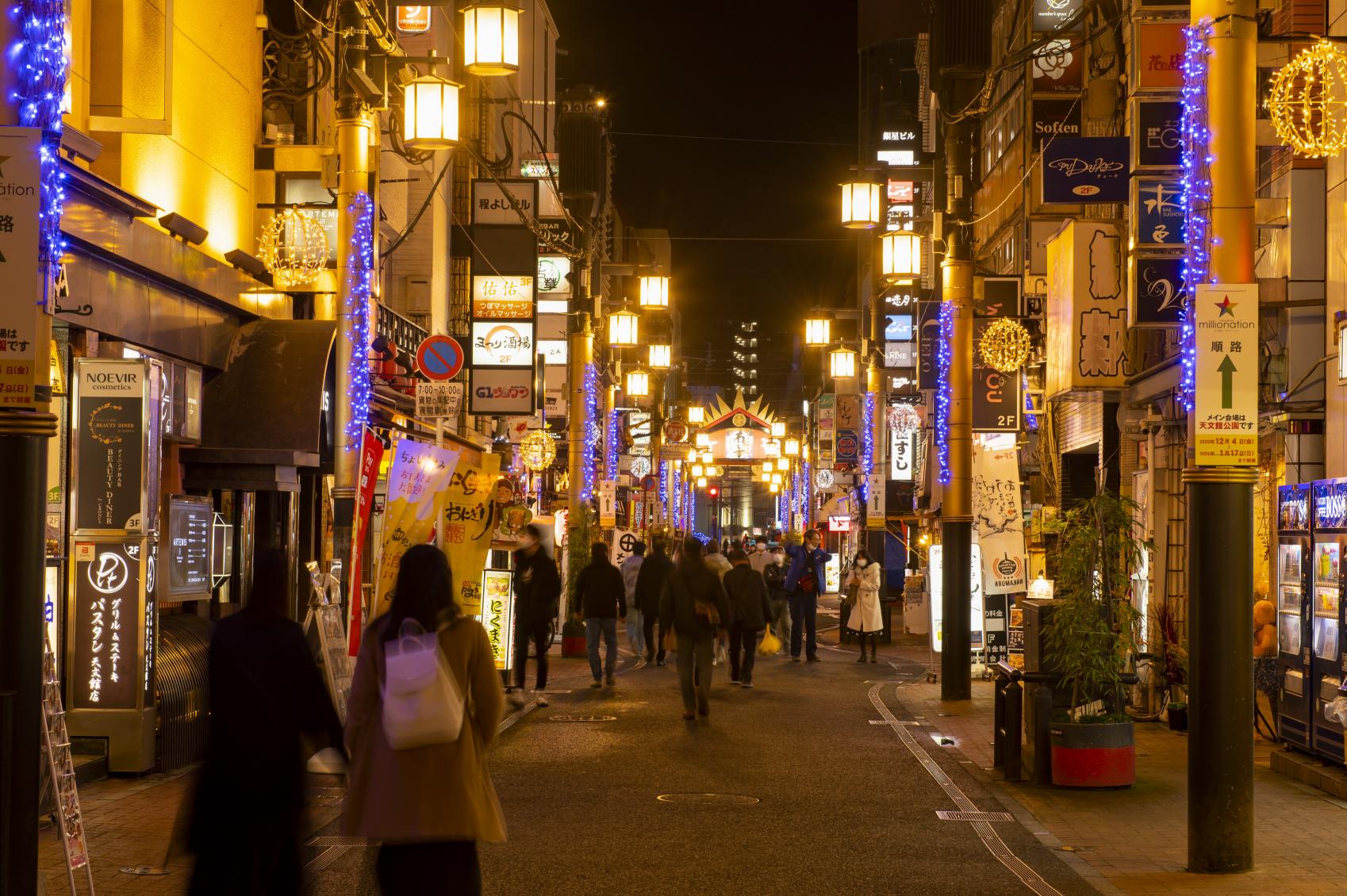
天文館
南九州一の繁華街として人気のスポット。江戸時代に、西洋文明を進んで取り入れた島津重豪公が1779年に天文観測や暦の作成などを行う施設「明時館(別名天文館)」を建てたことが名前の由来になっています。 黒豚とんかつやかごしまラーメン、白熊などの
www.kagoshima-kankou.comBest Food-Crawl Areas in Kyushu and How to Work Them
Dazaifu Tenmangu Approach Road
For that "grazing as you walk" feeling, no spot in Fukuoka delivers it better than the Dazaifu Tenmangu approach road. Umegae mochi is the star, with most shops operating from around 9:00 a.m. to about 6:00 p.m. as a rough guide. This isn't a place to load up on a big meal — it works best as a spot to fold sweets and light bites into a shrine visit.
The key is not to overload as soon as you arrive. Finish your shrine visit first, then work your way through one or two shops in small portions. Umegae mochi may look identical from stall to stall, but the sear on the shell, the crispness, and the character of the red bean filling vary subtly between shops. The author considers this a street that rewards a slow pace rather than a speed run. Stroll the approach road, try one where something catches your eye, walk a bit more, try another — that cadence feels right.
Dazaifu is an easy day-trip addition from central Fukuoka, pairing well with a morning shrine visit followed by an afternoon back in the city. Unlike early-rising market areas, this spot comes into its own not at dawn but "after breakfast, during a morning outing."
Yobuko Morning Market
Yobuko Morning Market has the most sharply defined time window of any food area in Kyushu. The street runs roughly 200 meters with about 50 stalls, and the action concentrates in the morning (approximately 7:30 a.m. to noon). Specific stalls and seasons can affect operating days and hours, so checking ahead before building your morning around it is recommended.
The approach is simple: arrive early, walk the full length first to scout, then decide your eating order. Markets reward grazing over going all-in at the first stall, so picking up small bites of seafood and snacks while soaking in the atmosphere fits the setting. From there, transition into a proper sit-down squid meal and the morning market exploration and the signature dish feel like one continuous experience rather than two separate events.
One thing to keep in mind: while the market technically runs until noon, stock starts thinning noticeably after 11:00 a.m. Treat Yobuko as a "breakfast-plus-stroll" block and plan your afternoon around Karatsu to the south. If Saga's seafood is your trip's anchor, starting here sets up the rest of the day with minimal waste.
Nagasaki Shinchi Chinatown
Nagasaki Shinchi Chinatown works less as a traditional food crawl and more as an urban grazing zone with built-in convenience. Roughly 40 shops fill about 250 meters across the four directional gates, and it's under ten minutes by streetcar from JR Nagasaki Station — minimal transit overhead.
The advantage here is that it's not a morning-only area. It runs from lunch through dinner, making it flexible. You could anchor a chanpon or sara-udon lunch here, take a break, and return for Chinese or Western-style fare in the evening. The distances are short, so switching restaurants mid-stroll comes naturally. The area doubles as a sightseeing zone in its own right, which means food never feels disconnected from the rest of your day — a distinctly Nagasaki benefit.
Rather than trying to eat everything in one sitting, splitting lunch (noodles) from dinner (a different genre) is gentler on the stomach. Nagasaki's cross-cultural menu means even the same small area offers real flavor variety. Eat, walk a few minutes, sit down somewhere new — it's the natural rhythm of urban touring here.
Yunotsubo Kaido (Yufuin)
If walkability is your priority in Yufuin, build around Yunotsubo Kaido. This main street runs right from Yufuin Station, so it's accessible even on a train-only trip, and it connects onsen-town (hot spring town) sightseeing with snacking in a single flow. The important thing to know is that many shops here are set up for buying and eating at a designated spot rather than full table service. Sampling sweets and small bites at intervals as you walk gives the visit its Yufuin character.
Time-of-day wise, the author finds the 2:00 p.m. snack window to be the sweet spot. Have a proper lunch elsewhere first, then graze through here on your afternoon stroll — a sweet or a light savory bite at a time. Going hard from the morning compresses your afternoon and leaves no room for a cafe stop or a scenic pause. Yufuin is a town best enjoyed as "the place where you savor the afternoon," and planning it that way keeps everything comfortable.
Yunotsubo Kaido rewards slowing your pace and browsing shop fronts over power-walking from one end to the other. Yufuin's atmosphere — the scenery, the air, the quiet — completes the experience as much as the food does. Prioritize rhythm over volume, and Yufuin fits perfectly.
Aso Monzen-Machi Shopping Street
For combining sightseeing and food in one walkable pocket, Kumamoto's Aso Monzen-Machi Shopping Street is hard to beat. It spreads out in front of Aso Shrine, so shrine visits and meals happen in the same orbit. The Aso area tends to feel car-dependent, but carving out walking time around this street noticeably improves trip density.
How long you spend here depends on whether you're sitting down for an Akaushi beef meal or just browsing for light bites. For a combined visit with the shrine, 60 to 90 minutes keeps things from feeling rushed. The shrine alone can feel quick, but add the shopping street — sampling a bite here, poking into a shop there — and the time adds up faster than expected. Aso's landscapes are vast, so having a "small, walkable unit" like the monzen-machi (temple-front town) in the mix gives the day a change of pace.
This area doesn't peak in the early morning like a market, and it's not an afternoon-sweets-only zone like an onsen-town strip. It's strongest as a midday bridge between sightseeing and lunch. If basashi is your Kumamoto City dinner plan, keeping your Aso eating light — a small bite at the shopping street — balances out the day.
ℹ️ Note
Kyushu food crawls organize well when you assign each time slot a role: mornings for markets, midday for noodles and set meals, afternoons for sweets, evenings for hot pot and grilled meat. Recognizing Yobuko as a morning-only type, Nagasaki as a lunch-through-dinner type, and Yufuin as an afternoon-stroll type eliminates most scheduling conflicts before they start.
Tips for Getting Your Kyushu Food Trip Right
Time Management Basics
Kyushu food trips get dramatically easier when you front-load your mornings. The reason is simple: markets that close by noon and approach roads and shopping streets that wind down by early evening are a recurring theme. As covered earlier, morning markets have hard cutoffs, and a spot like Yobuko becomes a missed opportunity if you plan a "lunch visit." Even along the Dazaifu approach road, shops including the umegae mochi vendors start the day early and taper off by evening, so prioritizing food over sightseeing on a given day means putting the first half of the action in the a.m.
On daily meal count, restraint actually increases satisfaction. A good target is 3 to 4 meals plus one snack per day. Kyushu's noodles, rice bowls, and meat dishes each deliver serious per-plate satisfaction, and while hopping between restaurants can create the illusion of endless capacity, energy tends to drop in the back half. The author finds that planning to share portions from the start is the most reliable way to prevent an itinerary from falling apart on a big-eating day. Solo travelers do best by spacing things out: noodles at lunch, a light snack in the afternoon, hot pot or grilled meat at night.
Shifting your timing also helps. Peak lunch crowds at popular restaurants tend to cluster between 11:30 a.m. and 1:30 p.m., so arriving in the early 11:00 window or pushing to the 2:00 p.m. side changes how predictable your wait becomes. Kyushu often demands real travel time between stops, so rather than cramming every specialty into one day, theming your days — "today is morning market and seafood," "today is city noodles and cafe food" — keeps both meals and sightseeing from getting shortchanged.
Food-Crawl Etiquette and Trash
The food crawl described in this article means visiting multiple shops and sampling along the way — not eating while walking down a busy street. This distinction matters throughout Kyushu's approach roads, onsen streets, and shopping arcades. The standard practice is to eat at shop fronts, benches, indoor seating, or designated areas. Eating while moving through a crowded corridor disrupts foot traffic, and strong aromas or drippy items need extra awareness around other people.
Trash management also shapes the experience. Use a shop's collection bin when available; otherwise, assume you're carrying it out and keep a small bag handy. Skewers, paper trays, cups, and wet wipes generate more clutter inside a bag than you'd expect, so even a basic sorting habit cuts down frustration. Onsen towns and shrine approach roads are scenic spaces, and respecting where you eat is part of enjoying the place itself.
💡 Tip
Even in areas described as "food-crawl friendly," stopping to eat is almost always the better move. Pause in front of a shop, finish your bite, then continue. The food tastes better that way, and the memory sticks.
Navigating Lines and Reservations
At popular restaurants, the stumble is usually misjudging the wait rather than the food itself. Lines forming before opening time are common at Kyushu's well-known spots. Seafood specialists, famous ramen shops, and trending set-meal places in particular shouldn't be approached with a "just drop in at lunch" mindset. The basic call is either arrive early and queue or lock in a reservation in advance.
For reservation availability, go by each restaurant's official information rather than third-party listing sites alone. Some accept online bookings, others are phone-only, and a few operate on a walk-in sign-up sheet. Misreading how a restaurant handles bookings can create dead time in your schedule. Tourist-area favorites can be unpredictable even on weekdays, so understanding each place's system in advance lets you sequence your travel stops more confidently.
Lunch crowds converge between 11:30 a.m. and 1:30 p.m., so targeting that window for a priority restaurant means budgeting wait time into the plan. Shifting to the early 11:00s or the 2:00 p.m. range smooths the transition to afternoon sightseeing. At night, areas like Fukuoka's Nakasu keep late hours, but individual stalls and restaurants vary widely — assuming "it's nighttime, so anything goes" doesn't hold up. Deciding upfront whether you want to treat the queue as part of the experience or optimize for throughput keeps your restaurant choices consistent.
Souvenir Strategy
Souvenirs work better when you plan backward from portability rather than scrambling at the end. The first rule: don't buy refrigerated or same-day items early in a multi-day trip. Fresh sweets and delicate goods may be wonderful to eat on-site, but they become a luggage headache on a touring itinerary. When your travel days are long, the timing of purchase effectively becomes quality control.
Kyushu, fortunately, has specialties that convert to souvenirs well. Kagoshima's karukan holds up at room temperature and packs easily. Fukuoka's mentaiko (seasoned cod roe) is a classic that travels with an ice pack. Satsuma-age also works — it's easy to serve at home and better suited as a personal take-home than as a hand-out gift. Designating one or two items like these as your souvenir picks lets you focus your on-site eating time on dishes that only work fresh from the kitchen.
Rather than chasing the lowest price, prioritize portability, giftability, and purchase timing. Sorting by recipient — family, yourself, coworkers — cuts decision fatigue, and drawing a clear line between "must eat on-site" and "travels well" sharpens both categories. Accepting that not everything needs to be consumed on the spot makes the entire Kyushu food trip easier to assemble.
Sample Itineraries: 1 Night / 2 Nights
When building an itinerary, start by locking in time-sensitive locations rather than listing dishes. Morning markets, approach roads, onsen experience facilities — places with narrow visiting windows go in first. Then fill the remaining lunch and dinner slots with noodles, hot pot, sashimi, and rice bowls. The author finds this sequence reduces missed-meal regret less than it reduces wasted transit — and the itinerary holds up better across prefectural borders.
1 Night, 2 Days: Fukuoka + Kumamoto
For a short, concentrated trip on public transit, this combination is the most practical. Day one starts in Fukuoka, with the Dazaifu shrine visit placed in the morning-to-late-morning window. Umegae mochi shops along the approach road are open from morning through late afternoon, but options narrow as the day goes on, so the front half of arrival day is the cleanest fit. Getting the shrine and approach-road snacking out of the way early means your afternoon and evening in Fukuoka stay flexible.
For dinner, the choice between a quick Hakata ramen and a motsu-nabe sit-down changes the night's shape. Ramen is lighter and keeps an evening stroll going; motsu-nabe turns dinner itself into a trip memory. Fukuoka's nightlife has enough depth that you can afford to split day one into "approach road for sweets, evening for savory mains" — a rhythm that prevents eating fatigue.
Day two: head to Kumamoto in the morning and divide the day into taipien for lunch, basashi if you're staying into the evening. Taipien's vegetables and light broth sit well on a transit day without dragging down the afternoon. Basashi, placed as the trip's closing act, leaves a vivid stamp of having actually traveled to Kumamoto. Fukuoka and Kumamoto connect smoothly by shinkansen or limited express, and even in two days you can cycle through "approach-road snacking," "city nightlife," and "castle-town regional cuisine" — three genuinely different food landscapes.
For this plan, push refrigerated souvenir purchases to the tail end of day two. Carrying something like mentaiko with an ice pack from day one is less efficient than consolidating near your departure point.
2 Nights, 3 Days: Nagasaki + Saga + Fukuoka
This western corridor route works even without a car. Day one puts Nagasaki in the spotlight, with Chinatown meals split across lunch and dinner. Nagasaki Station to Chinatown is a quick streetcar ride, and the city's compact scale makes it easy to layer sightseeing and eating from the moment you arrive. Chanpon at lunch, Turkish Rice or a Chinese-style dish for dinner — even eating twice in the same district doesn't feel repetitive because a walk in between resets your appetite. If time allows, Glover Garden between meals doubles as a post-lunch stroll. The grounds take about 1.5 to 2 hours at a comfortable pace and slot in neatly around mealtimes.
Day two: confirm Yobuko's morning slot first — this becomes the anchor for the entire trip. Working the morning market into a squid lunch creates a Saga food experience that transcends a simple meal. Yobuko's value concentrates in those morning hours, so even on a three-day trip, building outward from this time block gives you the most scheduling freedom. Afternoon options include drifting toward Karatsu for castle-town scenery — Karatsu Castle is manageable in 45 to 90 minutes including the grounds. Then head to Fukuoka, where the evening opens up for ramen or a casual drink.
Day three uses Fukuoka as a departure-day buffer. Rather than cramming in new experiences, a single bowl of ramen plus souvenir shopping brings things to a tidy close. Nagasaki runs on streetcars, the Saga area on JR and buses, and Fukuoka's rail network ties it all together — the route practically assembles itself from public transit connections. And because the food hubs in each prefecture sit close to stations and stops, the travel itself never becomes the burden.
ℹ️ Note
Nagasaki + Saga + Fukuoka works best when you assign each day a food peak: "Nagasaki lunch and dinner," "Yobuko morning," "Fukuoka departure-day wrap-up." Spacing the highlights this way prevents any single meal from blurring into the next, and three prefectures in three days doesn't feel hectic.
2 Nights, 3 Days: Yufuin + Beppu + Aso
For travelers who want both scenery and food, this route is best with a rental car. Yufuin, Beppu, and Aso are each reachable by public transit individually, but linking all three with scenic detours and roadside stops is where a car earns its keep. Day one: arrive in Yufuin and settle into an afternoon sweets session on Yunotsubo Kaido. The street is close to the station, so the onsen-town (hot spring town) vibe kicks in almost immediately, even on a travel day. Keep lunch light and spend the afternoon on sweets and browsing — that's the tempo Yufuin is built for.
Day two shifts to Beppu, with jigoku-mushi as the midday anchor. The Beppu Hell Tour runs 8:00 a.m. to 5:00 p.m. and fits a standard 2 to 2.5-hour visit on public transit, but coming from Yufuin with food and sightseeing to weave together, a car smooths the Kannawa-to-Kamegawa transitions. Placing jigoku-mushi after the Hell Tour connects what you've seen and what you eat. Beppu's "seeing" and "eating" happen so close together that you can wrap up sightseeing by afternoon and ease into an evening at an onsen inn or the city center.
Day three heads for Aso, following the shopping street snacks-to-Akaushi-beef-bowl progression. Aso's restaurants are scattered, and scenic pull-offs are tempting, so this is where the rental car's value becomes obvious. Work in the scenery during the morning, then anchor lunch with an Akaushi beef bowl — it's a strong closer. The three-day arc — Yufuin's gentle stroll, Beppu's experiential dining, Aso's sweeping landscapes and red-meat power — shifts the food impression cleanly with each stop.
Here too, consolidating souvenirs near the end makes sense. Anything requiring refrigeration is better picked up near Aso on the return leg than lugged through onsen towns from day one. A car gives freedom, but that same freedom makes it easy to pile on too many stops. Prioritize by the formula — afternoon-only onsen towns, midday experience dining, lunchtime meat bowls — and the two nights stay dense without tipping into exhaustion.
Wrapping Up: Your Next Steps and a Quick Checklist
- Narrow down your destination
- Pick one dish to build around first
- Place time-sensitive areas in the morning
A Kyushu food trip is the kind of thing that gets better once you stop planning and start moving. Choose one prefecture, one signature dish as your anchor, and build the rest around it. Leave enough slack in the schedule for the unplanned discovery — that's the meal that often ends up defining a Kyushu trip.
Related Articles
8 Best Hitou (Hidden Onsen) in Japan: Association-Certified Picks, Basics & How to Choose
Hitou (hidden/secret onsen) refers to remote hot springs prized for their seclusion and untouched atmosphere, while meitou (renowned onsen) highlights water quality, history, and reputation. This guide first clarifies the distinction, then hand-picks 8 inns from the Japan Association of Secluded Hot Spring Inns, comparing them across water quality, atmosphere, access difficulty, and travel style (verified Feb-Mar 2026).
8 Regional Winter Dishes to Try in Tohoku, Japan
Tohoku's long winters have shaped some of Japan's most satisfying regional cuisine. This guide covers eight dishes worth traveling for across Aomori, Iwate, Miyagi, Akita, Yamagata, and Fukushima, from hot pots and soups to rice bowls and ceremonial fare.
Your First Solo Trip in Japan: Planning, Choosing a Destination, and Beating the Nerves
Safety concerns, budget worries, dining alone, loneliness at night — plenty of would-be solo travelers in Japan get stuck before they even start. This guide breaks those anxieties into five manageable categories (safety, cost, loneliness, health, and trouble-shooting), then walks you through destination selection and a step-by-step preparation timeline.
12 Weekend Overnight Trip Itineraries in Japan You Can Actually Pull Off
Planning a weekend getaway in Japan works better when you start with travel time, budget, and transportation rather than a wish list of attractions. This guide compares 12 itineraries across the country using concrete benchmarks: Tokyo to Hakone in about 90 minutes, Tokyo to Niigata in roughly 2 hours, and Fukuoka Airport to downtown in just 10 minutes.