
8 Regional Winter Dishes to Try in Tohoku, Japan
8 Regional Winter Dishes to Try in Tohoku, Japan
Tohoku's long winters have shaped some of Japan's most satisfying regional cuisine. This guide covers eight dishes worth traveling for across Aomori, Iwate, Miyagi, Akita, Yamagata, and Fukushima, from hot pots and soups to rice bowls and ceremonial fare.
Tohoku's winters stretch on and on, and that persistence is exactly what gives the region's flavors their sharpest definition. This guide narrows down eight regional dishes across Aomori, Iwate, Miyagi, Akita, Yamagata, and Fukushima — six prefectures in northern Honshu, Japan — spanning hot pots, soups, rice dishes, and ceremonial cuisine that belong to the cold months. If you are planning a winter trip to northern Japan, these are the dishes that make the season worth braving. Even on a short itinerary, you should be able to decide what to eat, where to find it, and when it peaks, since seasonal timing and local food events are noted alongside each dish. Winter food in Tohoku goes beyond warming your body. The more you learn about each area's rice culture, coastal harvests, preservation traditions, and festive table customs, the more weight a single plate carries when you sit down to eat.
Why Tohoku's Regional Dishes Taste Best in Winter
The reason is straightforward: Tohoku's geography makes the connection between climate and cuisine unusually visible. The region encompasses six prefectures covering roughly 30% of Honshu's land area, yet its population sits at only about 8.7 million. Coastlines, basins, mountain valleys, and snow-heavy inland zones all produce distinct food traditions. A wide region with no single flavor identity — that layered diversity is what makes Tohoku winter cooking so compelling.
Regional cuisine, as cataloged by Japan's Ministry of Agriculture, Forestry and Fisheries (MAFF) in their "Our Local Dishes" database, refers to dishes rooted in local produce and climate that have been handed down through generations. In Tohoku, that means cold winters, heavy snowfall, preservation ingenuity, rice-growing expertise, and port-town seafood all show up on the plate. When you eat these dishes on location, they stop feeling like "local specialties" and start making sense as inevitable outcomes of the landscape.
Long Winters Shaped the Hot Pot and Soup Tradition
With months of bitter cold, it was only natural for Tohoku to develop a rich repertoire of dishes that warm from the inside. Akita's kiritanpo nabe uses pounded rice shaped around cedar sticks and grilled, then simmered in Hinai-jidori chicken broth so the toasted rice absorbs the savory stock — a single pot that unites the grain and the soup. Senbei-jiru from the Hachinohe area in Aomori (Aomori Prefecture, Japan) follows the same logic: special Nanbu senbei crackers designed for simmering are cooked into the broth, merging the starch and the soup into one.
Iwate's hittsumi is a rustic dish where wheat dough is pulled and torn by hand, then boiled with chicken, root vegetables, and mushrooms. Yamagata's imoni splits into two distinct personalities — a soy-sauce-based beef version in the inland areas and a miso-based pork version in the Shonai coastal district — but both are unmistakably winter fare, built around gathering over a steaming pot. These dishes share a quality beyond heat: they fill you up and sustain you. In cold country, a meal needed to do more than just be hot; it had to fuel you through the day.
Preservation and Fermentation Deepen Winter Flavors
Any account of Tohoku's winter table has to reckon with its preservation and fermentation heritage. In areas snowbound for months, techniques accumulated over centuries: drying fish, pickling vegetables, fermenting sauces, wringing every drop of flavor from stock ingredients. Akita's shottsuru nabe is the signature example. Shottsuru, a fish sauce made from hatahata sandfish, anchors the entire pot. The result is not simple saltiness but a layered, fermentation-driven richness that feels like it can reach your bones on a freezing night.
Kozuyu from the Aizu district of Fukushima (Fukushima Prefecture, Japan) preserves that ingenuity in an elegant form. Built on dried scallop stock with an odd number of ingredients — a custom tied to celebrations — it is a ceremonial soup where dried-goods wisdom and festive protocol converge in a single bowl. Azara from Kesennuma (Miyagi Prefecture, Japan) is not strictly a winter-only dish, but its combination of fish scraps, sake lees, and aged hakusai pickles speaks directly to the fishing-town instinct for preservation and reuse. When people describe Tohoku winter food as having "deep, quiet flavor," this is the foundation: umami built over time.
Winter Is Also When the Feasts Come Out
Ichigo-ni from the Aomori coast is a clear broth of sea urchin and abalone, named for the way the golden uni floating in the milky liquid resembles wild strawberries. According to MAFF documentation, it originated as simple fishermen's fare and later entered the ryotei (traditional fine-dining restaurant) circuit, eventually becoming established as a celebration dish. Rather than a peak-season winter item, it is best understood as a dish that brings a sense of occasion to the winter table.
Miyagi's harako-meshi, where rice is cooked in salmon broth and topped with salmon flesh and ikura (salmon roe), centers on the autumn season — roughly September through November. But it easily falls within reach of an early-winter trip, and its construction, with the ocean's richness condensed into a single bowl of rice, carries a quiet extravagance. Thinking of it as a "Tohoku feast for the autumn-to-winter transition" rather than slicing strictly by peak season makes it much easier to work into travel plans.
💡 Tip
A quick framework for choosing winter meals in Tohoku: onsen (hot spring) towns pair well with hot pots, port towns with briny soups, and castle towns with ceremonial dishes that carry historical protocol.
From a traveler's perspective, Tohoku regional cuisine pairs exceptionally well with place. At onsen towns, dishes like kiritanpo nabe, imoni, or shottsuru nabe — where the rising steam is part of the experience — feel right at home. Soaking in a snow-viewing bath and then sitting down to a hot pot is a satisfaction unique to cold-country travel. Pairing a hot-spring town visit with a guide like our Ginzan Onsen walking itinerary helps make the whole stay more concrete.
In castle towns and historic districts, what you taste goes beyond the ingredients. Eating kozuyu in Aizu means encountering the area's ceremonial customs and centuries of dried-goods culture, all in a single bowl. It is not a flashy dish, but eating it alongside the town's history gives it a clarity that food alone cannot provide. Tohoku's regional cuisine tastes even better in winter not just because cold sharpens your palate, but because landscape, seasonal customs, and the atmosphere of a trip all converge at once.
8 Tohoku Winter Dishes Worth Traveling For
Kiritanpo Nabe (Akita) — Hot Pot / Hinai-jidori Chicken & Rice Sticks / A Taste of Rice Culture
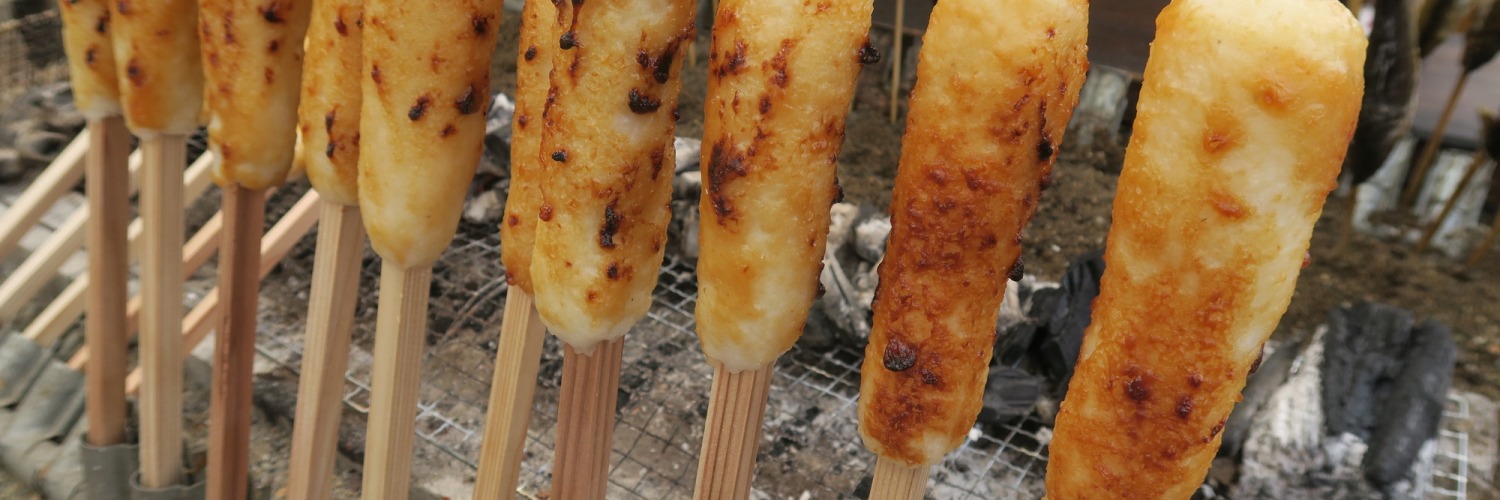
If there is one pot that represents Akita in winter, it is kiritanpo nabe. The starring ingredients are kiritanpo — pounded rice shaped around cedar sticks and charcoal-grilled — along with Hinai-jidori chicken, long onion, burdock root, seri (Japanese parsley), and mushrooms. The grilled rice absorbs the broth, and the line between soup and staple food disappears.
The flavor rests on a clear, soy-based broth drawn from Hinai-jidori chicken. When the charred kiritanpo enters, the surface holds its texture while the inside softens, releasing a gentle sweetness from the rice. It is a hot pot, yet it makes Akita's identity as a premier rice-growing region something you can literally taste.
The dish traces back to matagi (mountain hunter) and farming food culture — a way to use leftover rice without waste, turning it into a warm, filling meal during the coldest months. That snow-country pragmatism is part of its character. The Tabi Tohoku tourism portal lists it among Tohoku's representative regional dishes, positioning it not as a mere specialty but as a product of climate and staple-crop culture.
Winter compatibility is high. On a cold evening, lifting the lid of the pot at a ryokan (traditional inn) dinner releases an immediate wave of chicken broth and seri aroma. Even with snow piling up outside, the heat of the pot and the heft of the rice warm you from center to edge. In the Odate and Kazuno areas of Akita, local restaurants and onsen ryokan are the best places to encounter it, with the setting adding to the memory. The dish is most visible from autumn through winter; for home delivery, Ryokan Hiraori's official online shop offers a 3-4 serving kiritanpo nabe set at 8,640 yen (~$57 USD), typically available from October to February. Best for: anyone who wants to experience Tohoku's rice excellence through a hot pot.
東北の歴史と文化を感じる郷土料理|東北グルメ | 旅東北 - 東北の観光・旅行情報サイト
www.tohokukanko.jpSenbei-jiru (Hachinohe, Aomori) — Soup / Nanbu Senbei Crackers / A Uniquely Chewy Texture
Senbei-jiru, a staple of the Hachinohe area in Aomori (Aomori Prefecture, Japan), is a soup that doubles as a meal. The senbei used here are not snack crackers — they are a special variety of Nanbu senbei made specifically for simmering. Broken into a broth of chicken, vegetables, and mushrooms, they soften without disintegrating, holding a distinctive chewy resilience.
The first-bite impression is usually "this texture is way more interesting than I expected." Even after absorbing broth, the senbei do not go limp. They hold a springiness that sits somewhere between noodles and dumplings, in a category of their own. The broth is typically soy-based, with chicken and burdock root providing an earthy, unadorned flavor, but the real star is the senbei itself. This dish could only have emerged in a region where Nanbu senbei culture runs deep — shelf-stable crackers folded into everyday soup as a matter of local common sense.
Senbei-jiru fits winter in Hachinohe because it delivers warmth and substance in a single bowl. Sitting in a port-town diner with a steaming bowl in front of you, the look may be understated, but the first spoonful carries real satisfaction. It shows up not just in tourist-oriented restaurants but in neighborhood diners and market-area eateries. It suits lunch or dinner better than breakfast. Packaged sets with senbei and soup stock are widely available from retailers like Nanbu Senbei Dot Com and the Hasshoku Center online shop; with the pre-made broth, the whole process from pot to table takes around 18 minutes. The dish is available year-round, but it hits differently when the weather turns cold. Best for: anyone who wants textural surprise in their soup or hot pot.
Shottsuru Nabe (Akita) — Hot Pot / Hatahata Fish & Fish Sauce / Fermentation Takes Center Stage
Shottsuru nabe is the dish that most directly embodies Akita's fermentation culture. It is a hot pot built around hatahata sandfish, napa cabbage, leek, tofu, and mushrooms, with the defining element being shottsuru — a fish sauce made from fermented hatahata. The flavor it brings is not mere saltiness but a dense, layered umami.
This pot tastes fundamentally different from soy-sauce or miso-based hot pots. The first note is oceanic, but rather than hitting you with raw fishiness, it unfolds as a slow, fermentation-driven depth. Hatahata flesh is delicate, and as it simmers, it reinforces the broth's richness further. Akita's long history of preservation and fermentation supporting winter food culture finds its most accessible expression in this single pot.
The MAFF page on shottsuru nabe identifies it as a representative Akita regional dish, noting that hatahata's peak season falls in November through December. For a winter trip, that means early winter through year-end is when this dish is at its strongest. Eating it in a local restaurant on the Oga Peninsula or in Akita city, with snow-flecked wind outside, makes the fish-sauce steam feel like a reward in itself. Served at an onsen ryokan, it is the kind of meal that stays with you long after. Best for: anyone who wants to go deep on fermented flavors while traveling.
しょっつる鍋 秋田県 | うちの郷土料理:農林水産省
www.maff.go.jpHittsumi (Iwate) — Soup / Hand-Torn Wheat Dough & Vegetables / Gentle Home Cooking
Hittsumi from Iwate Prefecture (Japan) sits in the space between hot pot and soup — a dish that leans heavily toward home cooking. Wheat dough is kneaded, then pulled thin and torn by hand before being simmered with chicken, root vegetables, and mushrooms. The name comes from the tearing and pinching motions of preparation, making it one of those dishes where the cooking action became the name.
Seasonings vary by household and area, but the baseline is a soy-based broth where vegetable sweetness dissolves and the smooth dough slides in gently. It is more rustic than kiritanpo, more handmade-feeling than senbei-jiru, and eating it brings a comfort closer to "family soup" than "regional cuisine." The flour component makes it filling, and it works particularly well as a cold-day lunch.
Hittsumi suits winter not just because it is warm, but because it belongs to the scene of a family gathered around a pot. When served at a farmhouse minshuku (budget guesthouse) or a mountain-area restaurant in Iwate, it is the kind of dish where you taste the presence of people more than any bold flavors. Steam rising, a wood stove in the background — that is the setting this food was made for. Regional variation is broad enough that no single recipe captures it, but the common thread everywhere is the handmade quality at its core. The Iwate Fresh Noodle Cooperative Association has designated December 3 as Hittsumi Day, anchoring it as an official winter tradition. Best for: anyone who would rather taste everyday local life than chase spectacular dishes.
Imoni (Yamagata) — Hot Pot / Taro & Meat / Beef-Soy Inland vs. Pork-Miso Coastal
Yamagata's imoni is essential to any conversation about Tohoku's hot pot culture. Taro is the star, joined by meat, leek, and konnyaku. What makes it fascinating is that the flavor profile splits cleanly within the same prefecture: inland areas favor beef with soy sauce, while the Shonai coastal district goes with pork and miso. Same name, distinctly different impressions.
The inland beef-soy style carries a sweet-savory aroma close to sukiyaki, layering the sticky texture of taro with the richness of beef — satisfying with rice or sake. The Shonai pork-miso version leans heavier, with the rounded body of miso and pork fat warming you more assertively. Neither version is more "authentic" than the other; both simply reflect the local livestock and flavor preferences of their areas.
The dish originated in the farming custom of communally cooking harvested taro, and Yamagata is well known for its imoni-kai tradition of gathering along riverbanks with enormous pots. Although the autumn image is strongest, imoni loses nothing in winter. If anything, the sticky warmth of taro and the gratitude for a hot broth only increase as temperatures drop. Eating a small-pot serving of imoni at an onsen dining room or a neighborhood restaurant in snowy Yamagata reframes it not as banquet food but as winter sustenance. The dish appears most from autumn through winter. Best for: anyone who wants to taste how the same dish changes from one district to the next.
Kozuyu (Aizu, Fukushima) — Ceremonial Soup / Dried Scallop Stock / The Odd-Number Ingredient Custom
Kozuyu from the Aizu district of Fukushima (Fukushima Prefecture, Japan) is a soup that belongs more to the festive table than to everyday meals. Key ingredients include dried scallops, taro, carrot, wood ear mushroom, shirataki noodles, and mamefu (small wheat gluten puffs). Because the stock is built on dried scallops, the broth looks clear but carries a surprising depth of flavor — elegance and satisfaction in the same bowl.
What sets kozuyu apart is its link to Aizu's ceremonial customs. An odd number of ingredients is traditional, and the dish has been served at weddings, funerals, and New Year celebrations for generations. Dried-goods wisdom and the protocol of a castle town's formal table converge in a single serving. This is not rustic country soup; the word that fits better is "quiet refinement."
Harako-meshi (Miyagi) — Rice Dish / Salmon & Ikura / The Unity of Broth-Cooked Rice
Miyagi Prefecture's signature rice dish is harako-meshi, centered on the Watari town area and the coast south of Sendai (Miyagi Prefecture, Japan). The essential ingredients are salmon and ikura (salmon roe). What makes it distinctive is that the rice itself is cooked in the broth from simmered salmon, then topped with salmon flesh and ikura. The flavor is not applied after the fact — it is built into every grain.
The taste is more restrained than the vivid appearance suggests. Soy-seasoned rice absorbs the salmon's richness while the ikura adds a pop of brininess. The result sits between a seafood rice bowl and a takikomi-gohan (seasoned rice), quieter than one and more luxurious than the other. Its origins trace to the salmon culture of the Abukuma River estuary, and a tradition holds that it was presented to the feudal lord Date Masamune — a meeting of river and ocean in a single bowl.
Peak season runs mainly September through November, making it autumn-centered. Still, an early-winter itinerary puts it well within reach, and Watari town recognizes October 8 as Harako-meshi Day. Eating it as the air turns cold sharpens the pleasure of well-fattened salmon. At dining spots in Watari or Yamamoto, the sweet-savory aroma rising from the steaming rice makes the seasonal feast tangible. Best for: anyone who wants a standout rice course alongside the hot pots, not just another bowl of soup.
Ichigo-ni (Aomori Coast) — Clear Broth / Sea Urchin & Abalone / A Taste of Celebration
Ichigo-ni, associated especially with Hachinohe and Hashikami in Aomori (Aomori Prefecture, Japan), is a clear soup of sea urchin and abalone. The name comes from the way the golden-hued uni, floating in a faintly milky broth, resembles wild strawberries. Given the caliber of its core ingredients, this is not everyday fare — it belongs to celebrations and special occasions.
The flavor is refined: a broth seasoned simply with salt or light soy sauce, carrying the sweetness of uni and the concentrated savoriness of abalone. The appearance is tranquil, but the moment it reaches your palate, the ocean opens up. Originally a fishermen's dish, it entered the ryotei (fine-dining restaurant) world around the Taisho era according to MAFF records, and from there became established as ceremonial cuisine. In other words, it contains both the raw power of coastal ingredients and the polish of formal dining culture.
In terms of seasonality, summer uni comes to mind most readily, and the Hashikami Ichigo-ni Festival is held every year in late July. In winter, though, the relevant context is not the festival but the dish's role on New Year and celebratory tables. Rather than labeling it a strict winter-season food, think of it as a regional dish you want on a winter feast table. At a coastal inn with the scent of snow in the air, a small lacquer bowl of ichigo-ni offers a kind of luxury entirely different from hot pots — not boisterous but quietly celebratory. Aji no Kakunoya's canned ichigo-ni is a well-known product at 415 grams, yielding roughly two servings as a clear soup or pairing well with two cups of rice for a seasoned-rice variation. Best for: anyone who wants one special, refined bowl to add cultural depth to a winter trip.
Comparing All 8: Hot Pots, Soups, Rice, and Ceremony
Line up all eight dishes with a traveler's eye and the first thing that becomes clear is that "warm Tohoku comfort food" is not a single category. Some dishes demand a seated evening meal; others slip easily into a midday break between sightseeing stops. Whether you are after ocean flavor, the heft of meat and rice, or the gravity of ceremonial tradition — each axis changes the pick.
For this comparison, the hot pot group is kiritanpo nabe, shottsuru nabe, and imoni; the soup group is senbei-jiru, hittsumi, kozuyu, and ichigo-ni; and the rice dish is harako-meshi. When building an itinerary, useful questions include: which dish do you want warming you on the coldest night? Which is light enough for a midday meal? Are you leaning toward seafood, or toward meat and grain? Do you want to touch the ceremonial side of the food culture?
| Dish | Category | Warming Power | Travel-Day Convenience | Main Ingredient Focus | Cultural Weight |
|---|---|---|---|---|---|
| Kiritanpo Nabe | Hot pot | Very high — rice plus chicken broth warms from the core | Evening. Best enjoyed at a ryokan dinner or specialty restaurant | Rice & chicken | Everyday roots, but feels like a feast on the road |
| Shottsuru Nabe | Hot pot | Very high — fish sauce depth intensifies the perceived warmth | Evening. Pairs well with sake-producing areas and coastal inns | Seafood | Rooted in daily preservation culture |
| Imoni | Hot pot | High — the overall heat of the pot lingers well after the meal | Works for lunch or dinner, but evenings suit it best while traveling | Meat & taro | Everyday leaning, with a communal-gathering dimension |
| Senbei-jiru | Soup | High — the senbei add enough substance to keep it from feeling light | Midday-friendly. Easy to fit into a travel day | Wheat, stock, meat & vegetables | Strongly everyday and home-cooking |
| Hittsumi | Soup | High — the flour dough adds filling power | Midday-friendly. Works between sightseeing stops | Wheat, vegetables, chicken | Strongly everyday and home-cooking |
| Kozuyu | Soup | Moderate — gently warming, refined character | Lunch or dinner; shines in a kaiseki-style or formal setting | Dried goods & vegetables | Ceremonial. Represents the festive table tradition |
| Ichigo-ni | Soup | Moderate — a poised, bowl-sized warmth rather than enveloping heat | Lunch or dinner; best at a ryokan or Japanese restaurant at a relaxed pace | Seafood | Ceremonial. A celebration dish |
| Harako-meshi | Rice dish | Moderate — less immediate than a pot, but the broth-cooked rice satisfies deeply | Midday-friendly. A complete meal in a single serving | Rice & seafood | A seasonal treat |
If warming power alone drives the decision, the hot pot tier sits above the rest. Kiritanpo nabe has the most assertive rice presence, shottsuru nabe offers fermentation-driven heat that feels denser than the temperature alone, and imoni keeps warmth lingering through the taro and meat. The four soups deliver a different kind of warmth: senbei-jiru and hittsumi extend home-style comfort at a larger scale, while kozuyu and ichigo-ni ease the body with understated refinement. Harako-meshi does not have the drama of a bubbling pot, but the satisfaction of broth-infused rice holds its own as a cold-weather staple.
For fitting meals into a travel day, senbei-jiru, hittsumi, and harako-meshi are the most midday-friendly. Senbei-jiru gives you both carbohydrates and broth in one bowl, hittsumi is simple enough not to weigh you down, and harako-meshi closes out as a self-contained set meal — ideal on a day packed with movement. In contrast, kiritanpo nabe, shottsuru nabe, and imoni reward an unhurried evening, including the time to choose the right restaurant. Kozuyu and ichigo-ni can go either way, but their cultural backstory comes through most clearly in a ryokan or multi-course context.
Sorting by main ingredient, the seafood-forward options are shottsuru nabe, ichigo-ni, and harako-meshi — three clear entry points for anyone wanting to taste Tohoku's ocean. For meat presence, kiritanpo nabe with its Hinai-jidori chicken leads, and imoni offers the bonus of regional variation. Rice as a true protagonist appears in kiritanpo nabe (rice cooked inside the pot) and harako-meshi (rice cooked in fish broth) — same grain, completely different expressions. Within the soup group, senbei-jiru and hittsumi carry wheat traditions while kozuyu carries the dried-goods heritage: a contrast that is distinctly Tohoku.
Factoring in cultural depth, kozuyu and ichigo-ni sit firmly on the ceremonial side. Kozuyu embeds Aizu's festive-table protocol; ichigo-ni traces the arc from fishermen's fare to formal celebration. Meanwhile, senbei-jiru and hittsumi offer the opposite appeal — the warmth of ordinary home life, tasted on the road. Kiritanpo nabe, shottsuru nabe, and imoni occupy the middle ground: everyday at their roots, but elevated by the context of travel. Harako-meshi fits best as a seasonal treat — not ceremony, but the kind of dish a region looks forward to when the calendar turns.
A one-line cheat sheet: seafood lovers, go for ichigo-ni and harako-meshi; hot pot lovers, start with kiritanpo nabe, imoni, or shottsuru nabe; cultural depth seekers, choose kozuyu; home-cooking warmth seekers, pick hittsumi or senbei-jiru. Tohoku's regional cuisine cannot be reduced to "it is cold, so eat hot pot." Once you see which dishes carry the ocean, which carry the rice fields, which carry preservation wisdom, and which carry ceremonial customs, every meal becomes a different lens on the region.
Planning a Winter Food Trip to Tohoku: Timing and Strategy
When building an itinerary, it pays to lock down when each dish peaks before deciding what you feel like eating. Tohoku winter food mixes year-round staples with seasonal windows, and two similar-looking soups can have entirely different optimal months. Miyagi's harako-meshi centers on September through November, with some areas carrying the momentum into early winter; Watari town marks October 8 as Harako-meshi Day, giving a neat anchor for an autumn or early-winter itinerary. Akita's shottsuru nabe peaks with hatahata season in November through December, making the early-winter-to-year-end window its strongest stretch. Iwate's hittsumi is a year-round home staple, but December 3 is officially Hittsumi Day, aligning neatly with winter travel timing. Aomori's ichigo-ni is linked to the late-July Hashikami Ichigo-ni Festival for its summer face, but in winter it makes more sense to seek it as celebratory fare on ryokan menus or festive tables.
Where you eat within Tohoku matters just as much as when. Onsen towns in Akita and Yamagata are a natural fit for hot pots — arriving at your inn early, taking a snow-viewing bath, and then settling in for kiritanpo nabe, shottsuru nabe, or imoni is a rhythm that works specifically because you are not cramming too much into a winter day. For choosing onsen and day-trip baths, our guide to scenic open-air baths across Japan is a useful reference. Hot pots gain the most from an evening pace, and onsen towns are where you can feel their full potential.
Castle towns appeal to travelers who want the cultural backstory as much as the food itself. Eating kozuyu in Aizu reveals the dried-goods tradition and festive-table protocol all at once. The dish is not attention-grabbing, but consuming it alongside the town's history gives it a definition that flavor alone cannot provide. Building in time for a post-meal walk through the old streets rounds out the experience.
In Winter Tohoku, Narrowing Down Beats Covering Ground
Tohoku spans six prefectures and roughly 30% of Honshu's area. It is larger than a map suggests, and winter travel demands more buffer time for weather and transit delays. If food is the primary goal, focusing on one or two prefectures is the realistic approach. A good baseline is two nights / three days to three nights / four days. That gives enough room to eat a port-town rice dish at lunch, a hot pot at an onsen inn for dinner, and ceremonial cuisine in a castle town the next day, instead of spending every hour in transit.
For a two-night trip, one practical shape is "Miyagi coast plus Sendai area" built around harako-meshi, or "inland Akita plus onsen" built around shottsuru nabe and kiritanpo nabe — pick one theme and commit. A three-night trip opens the option of connecting areas with different culinary personalities, such as Aomori's coastal seafood and Iwate's home-style dishes. Trying to touch all six prefectures in a single trip tends to produce a checklist of names rather than memorable meals.
Pair Model Routes with Real-Time Transit Updates
For public-transit itineraries, the Tabi Tohoku model course guides are useful for understanding how to connect onsen towns, coastal areas, and historic districts at a regional scale. Starting from food alone makes routing harder; starting from a geographic framework and dropping meals in is more practical. For an overview of regional dishes by prefecture, the Tabi Tohoku page on Tohoku's regional cuisine offers a helpful map-level reference.
That said, winter demands more than a good route plan. Snowfall can reshape train and bus schedules, and road conditions affect drive times significantly. A conservative rhythm — one meal destination in the morning, one in the afternoon, one at the inn for dinner — tends to produce higher satisfaction than an ambitious eating itinerary. Reaching the restaurant you actually wanted to visit beats adding a third or fourth stop that the weather might compromise.

モデルコース | 旅東北 - 東北の観光・旅行情報サイト
www.tohokukanko.jpCross-Reference Official Sources for Timing and Events
The more locally rooted a dish is, the more variation you will find in restaurant availability and event tie-ins. A practical research sequence: start with the MAFF "Our Local Dishes" database to establish a dish's origin, region, and general seasonality, then move to prefectural and municipal tourism pages for ground-level detail. For example, confirm harako-meshi as a Miyagi regional dish with its seasonal window, then drill into Watari and Sendai-area specifics. Understand ichigo-ni as an Aomori coastal celebration dish first, then look at Hashikami and Hachinohe event schedules.
Following this order makes it easy to separate "dishes you must eat on location in winter" from "dishes available in winter but traditionally tied to a different season's event." Once you decide whether the trip's axis is hot pots, seasonal seafood, or cultural depth, building a winter food itinerary across Tohoku becomes a much more manageable task.
うちの郷土料理:農林水産省
www.maff.go.jpSouvenirs and Re-Creating the Flavors at Home
If you want to extend the trip at your kitchen table, Tohoku regional cuisine is surprisingly souvenir-friendly — as long as you start with dishes that translate well to packaged form. Aomori's ichigo-ni leads this category: Aji no Kakunoya's "Original Ichigo-ni" canned product at 415 grams is a well-established staple. Used as a clear soup, one can yields roughly two servings; mixed with the liquid into two cups of uncooked rice, it makes a serviceable seasoned rice that echoes the briny aroma of the original.
Among the hot pots, senbei-jiru sets and kiritanpo nabe sets are the most home-kitchen-ready options. Senbei-jiru sets — bundling Nanbu senbei with soup stock — are available from online retailers including the Hasshoku Center shop and Nanbu senbei specialists. Once you have your vegetables prepped, the process from heating the broth to dropping in the senbei and serving takes around 20 minutes, manageable even on a weeknight. Akita's kiritanpo nabe sets, available from producers like Kiritanpo no Saito's official shop and Ryokan Hiraori, include Hinai-jidori broth alongside the rice sticks, making it possible to assemble an approximation of the real thing. Fukushima's kozuyu also travels well in dried form — sets of dried scallops, mamefu, and other shelf-stable ingredients turn up at specialty shops. Rather than trying to bring home the intensity of fresh cooking, you are bringing home the method — a souvenir of the tradition itself.
At Home, Focus on the Stock and the Local Method
That said, the same dish tastes different in a restaurant in Tohoku and at your kitchen counter. With ichigo-ni, the immediate ocean aroma that hits when you lift a bowl near the coast, that sense of freshness at close range, belongs to the source. Kiritanpo nabe and senbei-jiru are similar: the way ingredients and broth fuse in the pot as you watch, the communal table-side steam — those are advantages of eating on location.
To close that gap as much as possible at home, invest your attention in the stock rather than piling on extra ingredients. For senbei-jiru, the timing of the senbei addition controls the texture dramatically — pull them before they go completely soft, keeping a slight core, and the result will feel closer to the Hachinohe version. For kiritanpo nabe, a Hinai-jidori-style chicken stock as the foundation plus restraint in adding the kiritanpo too early preserves both broth clarity and rice-stick texture. For kozuyu, resist the urge to make it lavish; keep the dried-scallop stock as the central axis and layer mamefu and root vegetables quietly, and the Aizu festive character holds. When re-creating regional dishes, not over-modernizing the recipe is itself a way of continuing the trip.
Temperature Control and Shelf Life Matter for Souvenirs
For souvenir logistics, shelf-stable options like canned ichigo-ni and dried-goods kozuyu sets are the easiest to handle. Fresh-type hot pot sets require more planning. Kiritanpo no Saito's fresh-ingredient nabe set, for instance, lists a four-day shelf life including the shipping date for some products — workable if you have a clear plan to cook soon after arrival. On trips where the return date is uncertain or transit time is long, using a shipping service rather than hand-carrying may be the simpler approach.
Even in winter, do not let cold outdoor temperatures lull you into skipping proper cooling. Seafood-based items, sets with fresh meat, and kits containing raw vegetables all degrade if carry time stretches. On the other hand, canned goods and dried-ingredient sets remain easy to buy late in a trip without worry. Since specifications vary by producer even for the same dish name, checking official product pages for volume, storage instructions, expiration dates, and shipping format before buying saves last-minute confusion.
Summary: Matching Dishes to What You Want from a Winter Trip in Japan
A concise guide to choosing: seafood lovers should look to ichigo-ni for refined coastal elegance and harako-meshi for the unity of salmon, roe, and broth-cooked rice. Hot pot enthusiasts will find their footing with kiritanpo nabe (chicken broth and rice satisfaction), imoni (regional variation worth tasting side by side), and shottsuru nabe (fermentation-driven depth). Cultural-depth seekers belong at the kozuyu table in Aizu, and anyone drawn to homestyle warmth will connect with hittsumi and senbei-jiru. To build the trip, start by narrowing your winter destination to one or two prefectures, then anchor the itinerary around one primary category — hot pot, seafood, or rice. Cross-reference Tabi Tohoku, prefectural tourism sites, and the MAFF database for timing and locations, then layer in onsen stays or sightseeing. Approached this way, a winter trip to Tohoku delivers not just great food but a richer stay overall.
Related Articles
8 Best Hitou (Hidden Onsen) in Japan: Association-Certified Picks, Basics & How to Choose
Hitou (hidden/secret onsen) refers to remote hot springs prized for their seclusion and untouched atmosphere, while meitou (renowned onsen) highlights water quality, history, and reputation. This guide first clarifies the distinction, then hand-picks 8 inns from the Japan Association of Secluded Hot Spring Inns, comparing them across water quality, atmosphere, access difficulty, and travel style (verified Feb-Mar 2026).
12 Must-Try Regional Dishes in Kyushu, Japan — A Prefecture-by-Prefecture Food Tour
Planning a food-focused trip through Kyushu? Listing local specialties by prefecture only gets you halfway there. The real trick is building your days around walkable hubs — Fukuoka's shrine approach roads, Saga's morning markets, Nagasaki's Chinatown — and slotting dishes into morning, noon, and night.
Your First Solo Trip in Japan: Planning, Choosing a Destination, and Beating the Nerves
Safety concerns, budget worries, dining alone, loneliness at night — plenty of would-be solo travelers in Japan get stuck before they even start. This guide breaks those anxieties into five manageable categories (safety, cost, loneliness, health, and trouble-shooting), then walks you through destination selection and a step-by-step preparation timeline.
8 Hidden Scenic Spots in Japan's Tohoku Region: Season, Difficulty, and Access Compared
Planning a trip to remote, stunning landscapes in Tohoku, Japan? Road conditions, ropeway schedules, and seasonal bus routes can dramatically change how difficult each spot is to reach. Mountain roads, aerial tramways, and seasonal services shift frequently, so